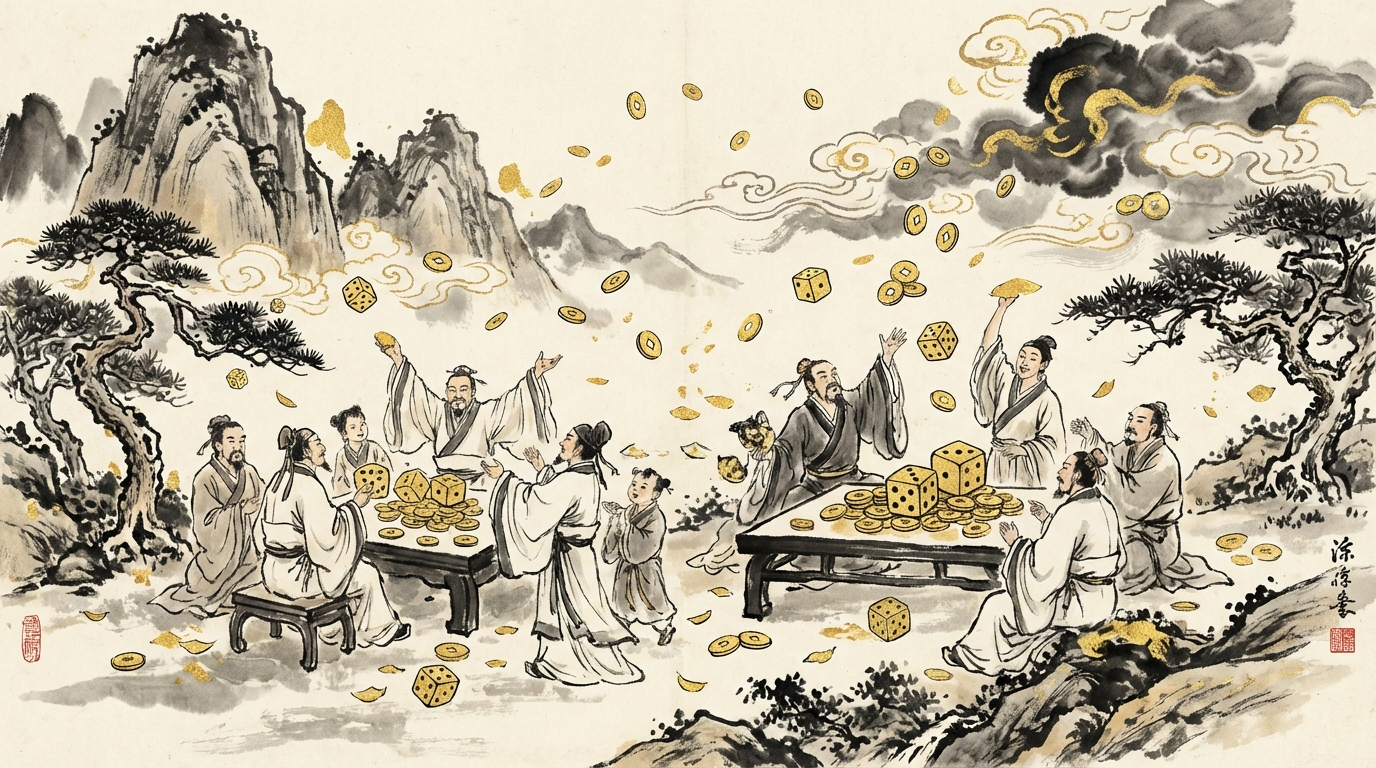
Pian Cai (偏财, piān cái), known as Indirect Wealth, is one of the Ten Gods (十神, shí shén) in BaZi (八字, bāzì). It is the element controlled by the Day Master (日主, rì zhǔ) with opposite polarity, representing windfall wealth, speculative gains, business acumen, the father figure, and a charming, entrepreneurial personality. People with strong Pian Cai are skilled at seizing unexpected financial opportunities.
This article is part of our Ten Gods series. New to BaZi? Start with the complete Ten Gods guide for an overview.
Every friend group has one. The person who walks into a casino and wins. The one who "knows a guy" for everything. Who gets invited to the private party, finds the deal nobody else saw, and somehow always lands on their feet financially even though they spend money like water. You ask them how they do it and they shrug. "I don't know, stuff just works out."
In BaZi, that's Pian Cai (偏财, piān cái). Indirect Wealth. The star of windfalls, social capital, and money that arrives through unexpected channels.
If Zheng Cai (正财, Direct Wealth) is your paycheck, Pian Cai is the bonus nobody told you was coming. Zheng Cai saves. Pian Cai spends. Zheng Cai builds slowly. Pian Cai hits jackpots. They're both wealth stars in the Ten Gods (十神) system, but they couldn't be more different in how they operate.
Curious about your wealth profile? Get your free BaZi reading and see which wealth stars show up in your chart.
What is Pian Cai?
Pian Cai is the element your Day Master (日主) controls, with the same polarity.
If you're a Yang Wood (甲木) Day Master, Wood controls Earth. Yang Earth (戊土) shares your polarity. That's your Pian Cai.
The "Pian" (偏) means "indirect" or "slanted." This is wealth that comes sideways. Not through the main door of your salary, but through the side window of opportunity, networking, speculation, and social connections. It's the investment that pays off. The tip from a friend. The inheritance you didn't expect. The client who finds you through a random connection.
In classical BaZi, Pian Cai was also associated with a man's secondary romantic partner (a concubine, in ancient context). The underlying logic is the same: Pian Cai is the resource that comes to you indirectly, outside the "proper" channels of Zheng Cai.
The personality of Pian Cai people
When Indirect Wealth dominates your chart, the effect goes well beyond finances. It shapes your whole approach to life.
You're naturally generous
This is the first thing people notice about strong Pian Cai types. You spend freely. You pick up dinner tabs without thinking about it. You lend money to friends and don't track it carefully. You give gifts that are too expensive for the occasion because you saw something and thought of someone.
This generosity isn't calculated. It's instinctive. Pian Cai people have a fundamentally abundant relationship with money. Where Zheng Cai people see a fixed pie that needs protecting, you see a constantly refilling well. Money comes in, money goes out, and somehow more comes in. Why stress about it?
The problem, of course, is that the well sometimes runs dry. More on that later.
Social capital is your real currency
Pian Cai people collect relationships the way Zheng Cai people collect savings. Your network is enormous. You know people in every industry, every social circle, every corner of whatever city you live in. And it's not superficial. You genuinely like people, remember their stories, and maintain connections that others let fade.
This social capital converts to financial capital in ways that look like luck to outsiders. You hear about an opportunity because you had dinner with the right person last week. You get the deal because the seller trusts you from a previous encounter. The "windfall" isn't really a windfall. It's the return on years of relationship investing.
Risk doesn't scare you
Where Zheng Cai people check the numbers three times before investing, you invest because it "feels right." You trust your gut on financial decisions. Sometimes that gut is spectacularly correct. Sometimes it's spectacularly wrong. But the fear of losing money rarely stops you from trying.
This risk tolerance makes you a natural investor, trader, and entrepreneur. You can handle the emotional volatility of markets, business cycles, and unpredictable income. What would give a Zheng Cai person ulcers feels normal to you.
The shadow side: money flows out as fast as it flows in
Here's the hard truth about Pian Cai. You're great at making money. You're terrible at keeping it.
The same generosity that makes you popular empties your bank account. The same risk tolerance that finds great investments also finds terrible ones. The same social spending that builds your network costs real money every single week. Dinners, drinks, events, gifts, travel with friends. It adds up.
I've seen Pian Cai people earn six figures and have nothing saved by the end of the year. Not because they're frivolous, but because their relationship with money is fundamentally fluid. Money is a tool for creating experiences and relationships, not a thing to be stored. The problem is that rent, taxes, and retirement don't care about your philosophy.
Pian Cai in your career
Where you flourish
Sales and business development. Your social skills, charm, and genuine interest in people make you a natural salesperson. Not the high-pressure, manipulative kind. The kind who builds real relationships and has clients who follow you from company to company because they like working with you.
Investment and trading. You have the risk tolerance and the instinct for opportunity that trading requires. Real estate speculation, stock trading, venture capital, angel investing. These fields reward exactly the "feel" that Pian Cai people have.
Entertainment and hospitality. Restaurants, nightclubs, event planning, hotels, tourism. Any industry built on social experience and people's enjoyment. You understand what people want because you want the same things.
Marketing and public relations. Turning relationships into business outcomes is basically the Pian Cai job description. Brand partnerships, influencer marketing, PR campaigns, community building. You do this naturally.
Entrepreneurship. Not the analytical, spreadsheet-driven kind. The "I see an opportunity and I'm going to make it happen" kind. You start businesses because you spotted something nobody else noticed, and you fund them through social connections and creative financing.
Where you struggle
Routine financial management. Anything that requires tracking, budgeting, or methodical financial discipline. Bookkeeping, compliance, audit work. You'd rather eat glass than reconcile a spreadsheet.
Roles requiring strict protocols. Government bureaucracy, regulatory compliance, standardized processes. Your instinct is to find the shortcut, the workaround, the creative solution. Environments that punish creativity and reward consistency aren't for you.
Long-term projects with delayed payoffs. Your energy is suited to quick wins and immediate returns. Ten-year infrastructure projects or slow-building academic careers test your patience past its breaking point.
Your ideal career depends on your full chart. Get your free BaZi reading for personalized career guidance.
Pian Cai in relationships
How you love
Generously and socially. You love taking your partner out, introducing them to your world, sharing experiences. Date nights are at the new place that just opened. Vacations are spontaneous. Gifts are frequent and thoughtful.
You're charming, warm, and easy to fall for. The early stages of a relationship with a Pian Cai person are intoxicating. You give your partner attention, adventure, and the feeling that life with you will never be boring.
The classical BaZi interpretation is worth mentioning here. In a man's chart, Pian Cai traditionally represents romantic interests outside the primary relationship. This doesn't mean every Pian Cai man cheats. It means there's an energy of attraction that draws people in broadly rather than exclusively. Strong Pian Cai people often have active social lives that include many close friendships with potential romantic undertones, and managing the boundary between friendship and flirtation is a recurring theme.
Challenges in love
Inconsistency. Your social schedule competes with quality time. Your partner might feel like they're sharing you with the entire city. Tuesday it's a client dinner. Thursday it's drinks with old friends. Saturday is someone's birthday. When is it just us?
Financial stress from different money styles. If your partner is a Zheng Cai type, expect friction about spending. Your "investment in the relationship" (that expensive dinner) looks like wasteful spending to them. Their "responsible saving" looks like missing out on life to you. This fundamental difference in money philosophy creates more relationship conflicts than you'd expect.
You might struggle with settling down. The same energy that makes you a social butterfly can make committed monogamy feel restrictive. This isn't about character. It's about energy. Pian Cai wants variety, novelty, and expansion. Partnership requires containment and consistency. Reconciling these pulls is the growth work for Pian Cai people in relationships.
Best matches
A partner with strong Zheng Guan (正官) or Zheng Yin (正印) energy provides the stability and structure that balances your fluidity. Someone with moderate Pian Guan energy can match your intensity without being destabilized by your unpredictability.
Pian Cai in different pillars
Year Pillar
Pian Cai in the Year Pillar suggests a family background with variable wealth, perhaps a father who was a businessman, a family with boom-and-bust financial patterns, or early exposure to money that came and went. You learned early that money is fluid, not fixed.
Month Pillar
This is Pian Cai's power position. Month Pillar Indirect Wealth indicates strong earning potential through networking, sales, and social capital. Your career will involve people, money, and opportunity, often in that order. This placement is common in successful entrepreneurs, salespeople, and investors.
Day Pillar (Spouse Palace)
Pian Cai here suggests a partner who is sociable, generous, and financially dynamic (for better or worse). The relationship will involve shared social activities and possibly shared financial ventures. It can also indicate that your partner's finances fluctuate.
Hour Pillar
Pian Cai in the Hour Pillar suggests that later-life wealth comes through unexpected channels. Inheritance, late-career investment success, or children who become financially successful. Your retirement may be funded less by savings and more by serendipity.
When Pian Cai is too strong
Excessive Pian Cai without balancing elements creates real problems.
Financial instability. Money comes in fast and goes out faster. You earn a lot but save nothing. Each financial success funds the lifestyle that creates the next financial crisis. It's a cycle that accelerates with age.
Scattered focus. Too many opportunities, too many social commitments, too many projects running simultaneously. You start many things and finish few. Your social calendar is full but your accomplishments feel thin.
Relationship complications. The social magnetism that draws people to you also creates situations. Flirtations that go too far. Friends who develop feelings. A partner who feels insecure because you're always surrounded by adoring people. Managing all of this requires emotional maturity that takes time to develop.
Health from overindulgence. Pian Cai people love good food, good drink, and good times. Excess in these areas catches up with your body eventually. Liver health, weight management, and the general consequences of living large deserve attention.
The remedy: introduce Zheng Guan (正官) structure or Zheng Yin (正印) grounding energy. In practical terms, build discipline systems: automated savings, spending limits, scheduled downtime from social activities.
When Pian Cai is weak or absent
Without Pian Cai energy, networking doesn't come naturally. You might struggle to convert social connections into financial opportunities. The "right place, right time" magic that Pian Cai people take for granted requires deliberate effort from you.
Weak Pian Cai people tend to be conservative with money (gravitating toward Zheng Cai strategies), prefer smaller social circles, and feel uncomfortable with financial risk. This isn't a flaw. It's just a different wealth style that favors predictability over opportunity.
Zheng Cai vs. Pian Cai: the real difference
Zheng Cai is your salary. Pian Cai is your side hustle.
Zheng Cai keeps score carefully. Pian Cai rounds up and moves on.
Zheng Cai people build wealth through patience. Pian Cai people build wealth through connections.
Zheng Cai fears losing what it has. Pian Cai trusts that more is coming.
The ideal financial life uses both. Save with Zheng Cai discipline. Invest with Pian Cai instinct. Most people naturally lean one direction. Knowing which way you lean helps you build in what's missing.
How to work with Pian Cai energy
Build guardrails for your generosity. You don't need to stop being generous. Just create a system. A "giving budget" that's separate from your bills. An automatic transfer to savings before you have a chance to spend it. Let the Pian Cai energy flow freely within boundaries that keep you solvent.
Say no to some invitations. Not all of them. Just some. Your social calendar is a river, and if you never dam it, nothing accumulates. Protect two or three evenings a week for yourself, your primary relationship, or just being alone. The FOMO will scream at you. Let it scream.
Invest with a system, not just instinct. Your instincts are often right, but they're not always right. Create investment rules that your instinct must pass through. Is this more than 10% of my portfolio? Have I researched it beyond what my friend told me? Can I afford to lose this money? If the answers don't line up, wait.
Develop your Zheng Cai muscle. Force yourself to track expenses for one month. Just one. See where the money actually goes. Most Pian Cai people are shocked by this exercise. Not because they're spending irresponsibly, but because they genuinely don't know. Awareness is the first step to balance.
Frequently asked questions
Is Pian Cai better than Zheng Cai for getting rich? Neither is better. They're different routes to the same destination. The wealthiest people in history typically had both: Zheng Cai discipline for preservation and Pian Cai instinct for growth. You need saving and earning. Accumulation and opportunity. Stability and risk.
Does Pian Cai mean I'll get lucky with money? Strong Pian Cai means you'll have more opportunities for windfall income, but "luck" still requires a strong enough Day Master to handle the wealth. If your Day Master is too weak to control the wealth element, money comes in but you can't hold onto it. Lucky earning, unlucky keeping.
Can Pian Cai people learn to save? Absolutely. It just requires building systems that work with your nature rather than against it. Automatic savings, visual goal tracking, and accountability partners work better than pure willpower for Pian Cai types. You need to outsource your discipline because your instinct is always to spend.
What about Pian Cai and relationships? Strong Pian Cai people benefit from partners who understand their social nature without feeling threatened by it. Trust and clear communication about boundaries matter more than trying to change each other's fundamental energy.
Your next step
Pian Cai is just one element of your wealth profile. Your full chart shows how Direct and Indirect Wealth interact with your Resource stars, Officer stars, and Output stars, and those combinations create very different financial realities.
Get your free BaZi reading now to discover your complete wealth map and learn how to make every star work in your favor.
Explore more Ten Gods: Zheng Cai (Direct Wealth) | Pian Guan (Seven Killings) | Shi Shen (Eating God) | Bi Jian (Friend Star)