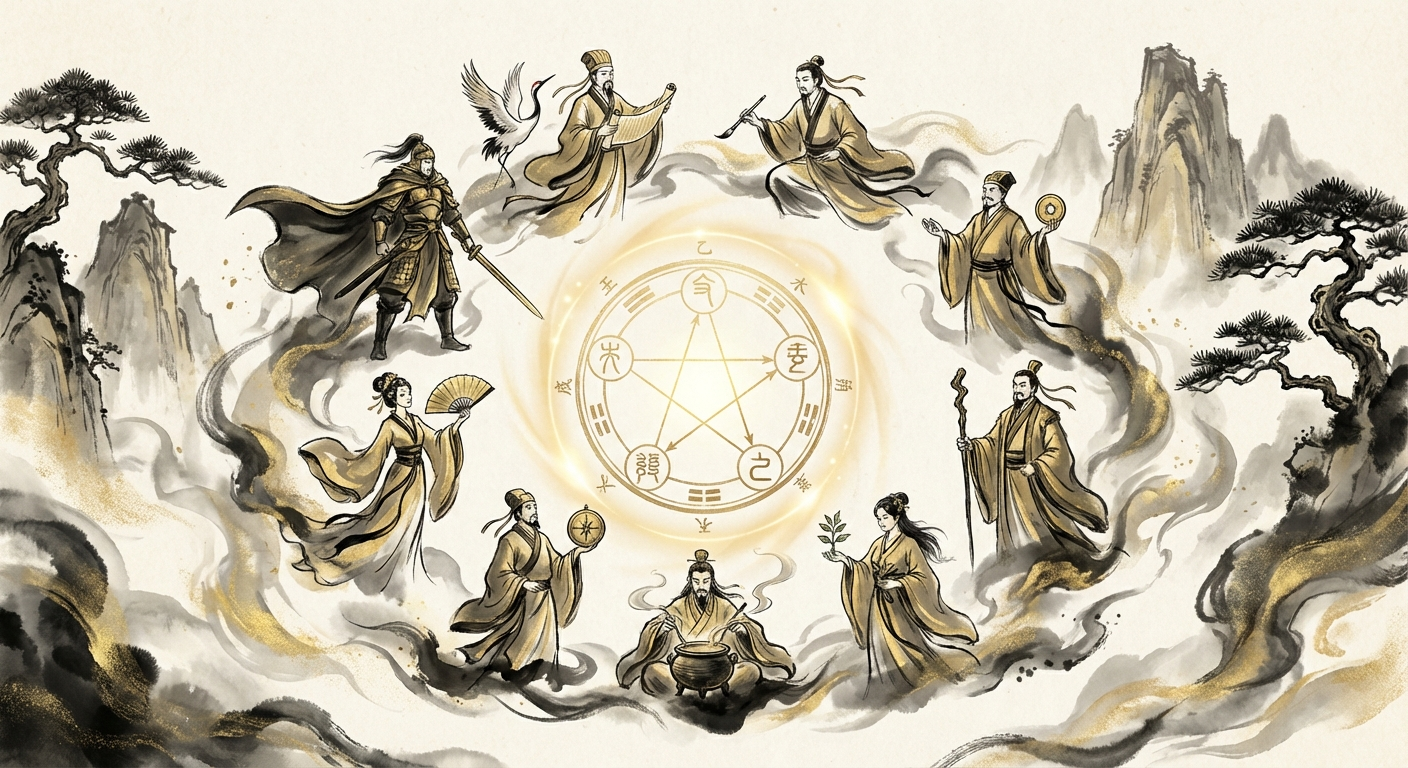
The Ten Gods (十神, shí shén) are ten relationship archetypes in BaZi (八字, bāzì) that describe how every element in a birth chart relates to the Day Master (日主, rì zhǔ) — the core self. Each of the Ten Gods represents a distinct energy pattern encompassing wealth, authority, creativity, output, and rivalry, and together they reveal a person's talents, challenges, career direction, and relationship dynamics within the Four Pillars of Destiny system.
Most people who get into BaZi start with their Day Master. "I'm a Yang Fire" or "I'm a Yin Metal." That's a solid start. But knowing your Day Master is like knowing you're the main character in a story. It doesn't tell you who else is in the story or what roles they play.
That's where the Ten Gods (十神, shí shén) come in.
The Ten Gods (十神, shí shén) are ten relationship archetypes in BaZi that describe how every element in your birth chart relates to your Day Master. Each god represents a distinct energy pattern — from wealth and authority to creativity and rivalry — and together they reveal your talents, challenges, career direction, and relationship dynamics.
The Ten Gods are the most useful analytical layer in BaZi. They turn a static grid of elements into a living drama, complete with allies, rivals, mentors, wealth sources, and authority figures. Once you understand them, your chart stops being a collection of Chinese characters and starts reading like a biography.
What are the Ten Gods?
Here's the core idea: every element in your BaZi chart has a relationship with your Day Master. That relationship depends on two things:
- The elemental interaction: Does this element produce me? Do I produce it? Does it control me? Do I control it? Or is it the same as me?
- The polarity match: Is it the same polarity (both Yang or both Yin) or opposite polarity?
These two axes create exactly ten possible relationships, the Ten Gods. Each one is a distinct archetype: a role, a type of energy, a pattern of behavior that shows up in your life.
Think of it like a workplace. Your Day Master is you sitting at your desk. The Ten Gods are your boss, your mentor, your rival, your creative muse, your paycheck, and your team, all defined by how their elemental energy relates to yours.
Curious which Ten Gods dominate your chart? Try our free BaZi reading. It maps all ten relationships instantly.
The ten gods: a complete guide
Let's walk through each one. I'll group them by elemental relationship, because that's how experienced practitioners actually think about them.
Same element: the self group
These are the elements that match your Day Master's element. They represent peers, people who are basically like you.
1. Friend / Companion (比肩, bǐ jiān)
Relationship: Same element, same polarity as your Day Master.
If you're a Yang Wood Day Master, another Yang Wood in your chart is your Friend. Same energy, same wavelength, same ambitions.
Friend stars represent peers, siblings, allies, and competitors who operate at your level. They're the people who understand you without explanation, but who also want the same things you do.
A chart heavy in Friend stars often belongs to someone who values teamwork and loyalty but may struggle with sharing resources. Think of two lions hunting together: powerful allies, but they still have to split the kill.
In life: Close friendships, business partnerships, peer support — but also competition and shared resources getting stretched thin.
2. Rob Wealth (劫财, jié cái)
Relationship: Same element, opposite polarity to your Day Master.
Rob Wealth is your Friend's more aggressive cousin. Where Friend is "we're on the same team," Rob Wealth is "we want the same prize and only one of us can have it."
People with strong Rob Wealth energy are bold, competitive, and unafraid to go after what they want even if it means stepping on toes. In classical BaZi texts, Rob Wealth is associated with financial volatility: money comes in fast but can leave just as quickly, often through generosity, gambling, or aggressive ventures.
But don't read this as purely negative. A controlled Rob Wealth star gives you the edge to compete in cutthroat environments. Entrepreneurs, athletes, and salespeople often have prominent Rob Wealth in their charts.
In life: Bold risk-taking, rivalry, financial ups and downs, charismatic but polarizing personality.
Element you produce: the output group
These are the elements your Day Master generates. In the Five Elements cycle, Wood produces Fire, Fire produces Earth, and so on. Output stars represent what you create, express, and put into the world.
3. Eating God (食神, shí shén)
Relationship: Element you produce, same polarity.
Eating God is one of the most beloved stars in BaZi. Its name sounds strange in English, but in Chinese metaphysics, "eating" represents enjoyment and abundance. This is the star of creativity, pleasure, artistic expression, and a good life.
People with strong Eating God energy are the ones who make everything look effortless. They cook beautiful meals, write compelling stories, crack jokes that land perfectly, and somehow always know the best restaurant in town. There's a natural flow to their output — it comes out polished without seeming forced.
Eating God also represents a kind of protective intelligence. It's the element that controls the Seven Killings star (more on that below), acting as a natural shield against pressure and aggression.
In life: Artistic talent, culinary skills, teaching ability, content creation, a life rich in sensory pleasure. People with prominent Eating God often gravitate toward food, arts, entertainment, or education.
4. Hurting Officer (伤官, shāng guān)
Relationship: Element you produce, opposite polarity.
If Eating God is the artist who plays by the rules, Hurting Officer is the rebel who breaks them. This star's Chinese name literally means "hurting the officer", clashing with authority and conventional thinking.
Hurting Officer people are brilliant, unconventional, and often a little dangerous. They see what others miss, say what others won't, and create work that challenges the status quo. Many of the most innovative thinkers in history had strong Hurting Officer energy: they weren't content to fit in, so they redefined the categories.
The downside? Hurting Officer can create friction with authority figures, bosses, and traditional structures. It can also lead to restlessness, always chasing the next idea, never finishing the last one.
If you're a Hurting Officer type wondering why you keep clashing with your manager, it's not a personal failing. It's baked into your energetic DNA. The solution isn't to suppress it, it's to find environments that reward original thinking. (Our career guide goes deeper on this.)
In life: Innovation, disruption, sharp wit, unconventional career paths, resistance to authority, creative genius paired with social friction.
Element that produces you: the resource group
These elements generate your Day Master's element. Water nourishes Wood, Wood feeds Fire, and so on. Resource stars represent support, knowledge, nurturing, and protection.
5. Direct Resource (正印, zhèng yìn)
Relationship: Element that produces you, opposite polarity.
Direct Resource is the loving parent, the patient teacher, the institution that has your back. It's classical education, credentials, stable support, and inherited wisdom.
People with strong Direct Resource tend to be well-educated, well-spoken, and highly valued in organizations. They absorb knowledge naturally and often hold positions of respect, not because they fight for power, but because their competence is obvious.
A Direct Resource person's home often has bookshelves. They believe in the system, in doing things the right way, in credentials and proper channels. This gives them stability but can also make them overly dependent on institutional validation.
In life: Academic success, strong family support, love of learning, respected reputation, organizational loyalty, sometimes over-reliance on authority figures or degrees.
6. Indirect Resource (偏印, piān yìn)
Relationship: Element that produces you, same polarity.
If Direct Resource is the university professor, Indirect Resource is the self-taught hacker who learned everything from YouTube and obscure forums.
Indirect Resource represents unconventional knowledge, intuition, esoteric wisdom, and self-directed learning. People with this star are drawn to niche subjects, alternative approaches, and knowledge that exists outside the mainstream. BaZi practitioners themselves often have strong Indirect Resource — it's the star that pulls you toward metaphysics, psychology, and "how does this really work?" thinking.
In traditional texts, Indirect Resource also has a more cautious reputation. It's sometimes called the "Owl" (枭, xiāo) because it can indicate overthinking, loneliness, or difficulty translating knowledge into practical results. The antidote? Pairing Indirect Resource with Output stars (Eating God or Hurting Officer) — when unconventional wisdom meets creative expression, remarkable things happen.
In life: Self-education, niche expertise, research skills, spiritual interests, alternative medicine, technology, sometimes isolation or impractical knowledge.
Want to see which Resource stars appear in your chart? Get your free reading and check your Ten Gods breakdown.
Element you control: the wealth group
These are the elements your Day Master overcomes. Wood controls Earth, Fire controls Metal, and so on. In BaZi, the element you can command and direct represents your wealth potential.
7. Direct Wealth (正财, zhèng cái)
Relationship: Element you control, opposite polarity.
Direct Wealth is the steady paycheck, the reliable income, the savings account that grows slowly but surely. It's earned through consistent effort, proper channels, and playing by the rules.
People with strong Direct Wealth are financially disciplined. They budget, save, invest conservatively, and build wealth over time rather than chasing windfalls. In traditional BaZi, Direct Wealth also represents the spouse (in particular the wife in a man's chart), because marriage in classical Chinese culture was partly an economic arrangement — a stable, committed partnership.
If your chart has prominent Direct Wealth, you're likely someone who values financial security and is willing to work steadily for it. The risk is becoming too focused on money at the expense of creativity or adventure.
In life: Salary income, financial stability, conservative investing, dutiful partnerships, practical money management.
8. Indirect Wealth (偏财, piān cái)
Relationship: Element you control, same polarity.
Indirect Wealth is the bonus, the side hustle, the unexpected windfall. Where Direct Wealth is your salary, Indirect Wealth is the investment that pays off, the business deal that lands, or the inheritance that arrives.
People with strong Indirect Wealth tend to be generous, socially connected, and comfortable with financial risk. They often have multiple income streams and a knack for spotting opportunities others miss. They're the ones who buy property on a hunch and watch it triple in value.
The flip side? Indirect Wealth people can be careless with money precisely because it comes easily. What arrives fast can leave fast too especially without the grounding influence of Resource or Earth elements in the chart.
In traditional texts, Indirect Wealth also represents the father, social connections, and "liquid" assets, things that flow rather than stay fixed.
In life: Investment income, entrepreneurship, social networking, generosity, financial risk tolerance, multiple revenue streams.
Element that controls you: the power group
These are the elements that overcome your Day Master. Metal controls Wood, Water controls Fire, and so on. In BaZi, the element that governs you represents authority, structure, discipline, and career status.
9. Direct Officer (正官, zhèng guān)
Relationship: Element that controls you, opposite polarity.
Direct Officer is the boss you respect, the law you follow, the structure that keeps society running. It's legitimate authority that earns compliance through fairness rather than fear.
People with strong Direct Officer are natural rule-followers who thrive in structured environments. They're often drawn to government, law, corporate management, or any field where hierarchy and procedure matter. They're reliable, principled, and command quiet respect.
In classical BaZi, Direct Officer is one of the most favorable stars for career advancement. It represents official rank, recognition, and steady professional growth. A chart with a well-placed Direct Officer often belongs to someone who climbs the ladder methodically and earns their position through competence and character.
In life: Career success through proper channels, respect for authority, management ability, government or corporate careers, principled leadership.
10. Seven Killings (七杀, qī shā)
Relationship: Element that controls you, same polarity.
Seven Killings is the most intense star in the entire Ten Gods system. Where Direct Officer is the mentor who guides you with a firm hand, Seven Killings is the drill sergeant who pushes you to your absolute limit..
The name sounds alarming, and in classical texts, it was considered dangerous. Seven Killings is about extreme pressure, aggression, power struggles, and ruthless ambition. But here's what those old texts sometimes miss: pressure creates diamonds.
People with prominent Seven Killings are often the most accomplished individuals in a room. They've been forged by challenge. They don't just handle stress — they're fueled by it. Military leaders, elite athletes, successful surgeons, and high-stakes entrepreneurs frequently have strong Seven Killings energy.
The key is whether Seven Killings is controlled in the chart. When Eating God or Direct Resource balances Seven Killings, you get ambition with wisdom — a person who channels intense drive into extraordinary achievement. When Seven Killings runs unchecked, you get burnout, aggression, or self-destructive behavior.
In life: High-pressure careers, military or competitive environments, strong willpower, authority through power rather than position, transformation through adversity.
How to find the Ten Gods in your chart
Every character in your BaZi chart — all eight of them, across the four pillars — has a Ten Gods relationship with your Day Master. Here's how to figure it out:
- Identify your Day Master — the Heavenly Stem of your Day Pillar
- Look at every other element in your chart (the other three Heavenly Stems plus the hidden stems inside each Earthly Branch)
- Determine the elemental relationship — same element, produces me, I produce, controls me, I control
- Check the polarity — same (Yang-Yang or Yin-Yin) or opposite (Yang-Yin)
For example, if your Day Master is Yang Wood (甲):
| Element in chart | Relationship | Ten God |
|---|---|---|
| Yang Wood (甲) | Same element, same polarity | Friend (比肩) |
| Yin Wood (乙) | Same element, opposite polarity | Rob Wealth (劫财) |
| Yang Fire (丙) | I produce, same polarity | Eating God (食神) |
| Yin Fire (丁) | I produce, opposite polarity | Hurting Officer (伤官) |
| Yang Earth (戊) | I control, same polarity | Indirect Wealth (偏财) |
| Yin Earth (己) | I control, opposite polarity | Direct Wealth (正财) |
| Yang Metal (庚) | Controls me, same polarity | Seven Killings (七杀) |
| Yin Metal (辛) | Controls me, opposite polarity | Direct Officer (正官) |
| Yang Water (壬) | Produces me, same polarity | Indirect Resource (偏印) |
| Yin Water (癸) | Produces me, opposite polarity | Direct Resource (正印) |
Don't want to do the math yourself? Our free reading tool calculates all your Ten Gods automatically.
The pillar matters: where a god appears changes its meaning
The same Ten God means different things depending on which pillar it sits in. Think of the four pillars as four stages of life and four domains of experience:
Year Pillar — Social World & Early Life (ages 0–15) A Seven Killings in the Year Pillar might mean a tough childhood with strict or absent authority figures. An Eating God here often indicates being born into a family that valued creativity or good food — an environment where self-expression was encouraged from the start.
Month Pillar — Career & Young Adulthood (ages 16–30) This is the pillar most connected to your professional life. Direct Officer in the Month Pillar is a classic indicator of corporate career success. Hurting Officer here often signals someone who struggles with traditional employment but shines as an independent professional or creative.
Day Pillar — Self & Marriage Your Day Master is here, so the Earthly Branch of the Day Pillar (the Day Branch) reveals the hidden Ten Gods closest to your core self. These deeply influence your marriage and intimate relationships. Direct Wealth in the Day Branch for a man, or Direct Officer for a woman, is a traditional indicator of a stable marriage.
Hour Pillar — Aspirations & Legacy (ages 45+) The Hour Pillar represents your ambitions, your children, and how you're remembered. Strong Resource stars here often indicate late-life wisdom and support in old age. Wealth stars suggest financial comfort in retirement.
Putting it all together: practical applications
Understanding the Ten Gods isn't just academic. Here's how practitioners actually use them:
Career selection
Your dominant Ten Gods point directly to career paths. Direct Officer types thrive in government and corporate settings. Eating God types excel in creative industries and food businesses. Seven Killings types dominate in competitive, high-pressure fields. Our career guide maps this in detail.
Relationship dynamics
The relationship between your Ten Gods and your partner's chart reveals compatibility patterns that go far deeper than simple element matching. A woman with strong Hurting Officer energy will naturally clash with a partner's Direct Officer energy — understanding this prevents years of confusion.
Timing major decisions
When your Luck Cycle brings a particular Ten God energy, it activates that archetype in your life. A Luck Cycle bringing Direct Wealth? Steady financial growth. One bringing Seven Killings? Prepare for pressure that can either break or remake you.
Self-awareness
Perhaps most the Ten Gods give you language for patterns you've always felt but couldn't name. "I always clash with authority" isn't a character flaw — it might be strong Hurting Officer energy that needs the right outlet. "I keep giving money away" isn't irresponsible — it might be Rob Wealth or Indirect Wealth expressing itself. Understanding the pattern is the first step to working with it instead of against it.
See your Ten Gods
Your BaZi chart contains a unique combination of Ten Gods, some prominent, some hidden, all interacting. Understanding which gods dominate your chart is like getting the character sheet for a game you've been playing blind.
Enter your birth details on Eastern Fate and instantly see your complete Ten Gods analysis — which archetypes shape your personality, career, relationships, and life path.
Discover Your Ten Gods at Eastern Fate →
Frequently Asked Questions
What are the Ten Gods in BaZi?
The Ten Gods (十神) are ten relationship archetypes derived from how each element in your BaZi chart interacts with your Day Master. They are determined by two factors: the elemental relationship (produces, controls, same, produced by, controlled by) and polarity (same or opposite Yin/Yang). The ten archetypes are: Friend, Rob Wealth, Eating God, Hurting Officer, Direct Resource, Indirect Resource, Direct Wealth, Indirect Wealth, Direct Officer, and Seven Killings.
How do I find my Ten Gods?
First identify your Day Master (the Heavenly Stem of your Day Pillar). Then examine every other element in your chart — the three remaining Heavenly Stems plus hidden stems inside each Earthly Branch. For each element, determine whether it's the same element, produces you, you produce it, controls you, or you control it, then check the polarity match. This gives you one of the ten archetypes. Our free BaZi reading tool calculates all Ten Gods automatically.
Which Ten God is best for career success?
There is no single "best" Ten God for career success — it depends on the career type. Direct Officer (正官) favors structured careers like government and corporate management. Eating God (食神) excels in creative industries and food businesses. Seven Killings (七杀) thrives in high-pressure, competitive environments. Hurting Officer (伤官) suits unconventional and entrepreneurial paths. The key is matching your dominant Ten Gods to a career environment that rewards that energy.
Can the Ten Gods predict wealth?
The Wealth Gods — Direct Wealth (正财) and Indirect Wealth (偏财) — indicate your relationship with money, not a specific amount. Direct Wealth suggests steady earned income through consistent effort. Indirect Wealth points to windfall income, investments, and multiple revenue streams. A chart with strong Wealth Gods supported by a healthy Day Master typically indicates strong financial potential.
What to read next
- Your Day Master: The Most Important Thing in Your BaZi Chart — Know yourself before analyzing the gods
- How to Read a BaZi Chart: A Step-by-Step Guide — The complete framework for chart reading
- The Five Elements: Which One Are You? — Understand the building blocks behind every Ten God
- BaZi Career Guide: Find Your Ideal Path — See how Ten Gods map to specific career paths
- BaZi Wealth Secrets: Your Money Blueprint — Detailed look into Direct and Indirect Wealth