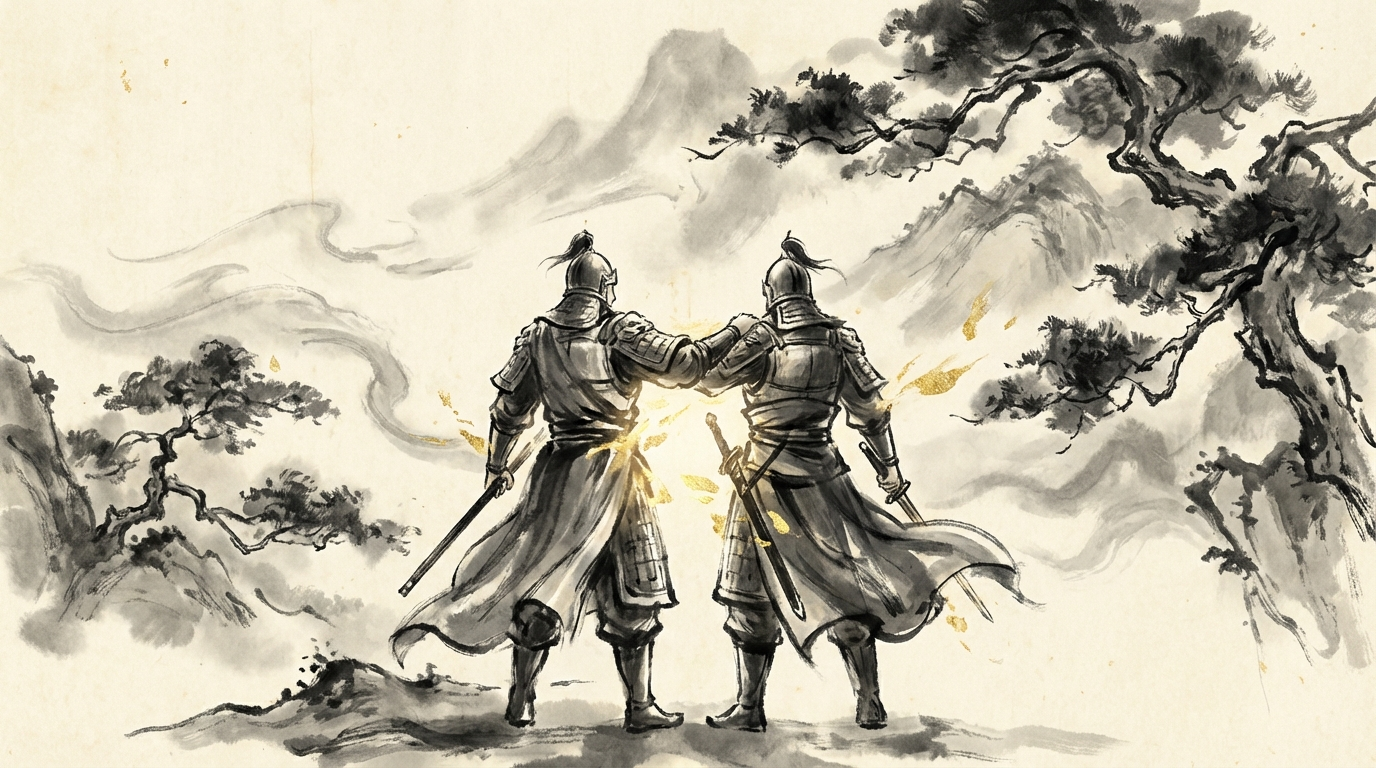
Bi Jian (比肩, bǐ jiān), known as the Rob Wealth or Friend Star, is one of the Ten Gods (十神, shí shén) in BaZi (八字, bāzì). It represents the element that shares the same Five Element type and polarity as the Day Master (日主, rì zhǔ), symbolising peers, independence, self-reliance, and the energy of 'shoulder to shoulder' equality. A strong Bi Jian in a chart indicates a fiercely independent personality that prefers self-sufficiency over dependence.
This article is part of our Ten Gods series. New to BaZi? Start with the complete Ten Gods guide for an overview.
You've seen this person at every gym. They're in the corner doing their own routine, not following a class, not chatting between sets, not checking what anyone else is doing. Earbuds in, head down, working. If you interrupt them, they're polite but brief. They're not here to make friends. They're here to get better. At what? Doesn't matter. That's not your business. They just need to be better today than they were yesterday.
That's Bi Jian (比肩, bǐ jiān). The Friend Star. The self star. The energy of independence, self-reliance, and the refusal to need anyone's help.
The name translates roughly as "shoulder to shoulder," which captures the energy perfectly. Bi Jian is the person standing next to you at the same level. Not above you, not below you, not in charge and not following. Just... beside you. Equal. An ally if your goals align, a competitor if they don't. And if you ask for help, they'll give it, but they'd rather you didn't need it.
In the Ten Gods (十神) system, Bi Jian is one of the two "self" stars (the other being Jie Cai (劫财, Rob Wealth)). Understanding Bi Jian tells you a lot about how you relate to peers, competition, independence, and the fundamental question of whether you need other people at all.
Want to see your self-stars? Get your free BaZi reading and discover your Ten Gods profile.
What is Bi Jian?
Bi Jian is the same element as your Day Master (日主), with the same polarity.
If you're a Yang Wood (甲木) Day Master, another Yang Wood in your chart is your Bi Jian. Same element. Same polarity. Same team. Essentially, it's another "you" in your chart.
This creates a straightforward dynamic: peers. People who are like you, at your level, with your abilities. Siblings. Classmates. Colleagues at the same rank. Business partners. Close friends who share your interests and capabilities.
The relationship with wealth is important here. Bi Jian competes for your wealth elements. When there are more "you" in the chart, the same pool of wealth gets split more ways. This is why excessive Bi Jian energy often correlates with financial competition, shared resources getting stretched thin, or the feeling that there are too many people chasing the same opportunities.
The personality of Bi Jian people
When the Friend Star dominates a chart, the result is someone with a powerful sense of self. Literally. Your identity, your independence, and your relationship with yourself are unusually strong.
Self-reliance is your religion
You don't ask for help. Not because you're proud (though you are), but because you genuinely believe you can handle it yourself, and you usually can. From changing a tire to solving a business problem to processing grief, your first instinct is always "I'll figure this out on my own."
This independence was probably forged early. Maybe you were the middle kid who learned to fend for themselves. Maybe your parents were too busy for hand-holding. Maybe you just always preferred doing things your way. Whatever the origin, the result is an adult who treats self-sufficiency as a core value, not just a skill.
The strength of this is obvious: you get things done without waiting for permission, instruction, or assistance. You're reliable because you depend on yourself, and you rarely let yourself down.
The weakness is harder to see: you struggle to accept help even when you need it. You interpret needing support as failure. And you may push away people who genuinely want to help, not because you don't want the help, but because accepting it feels like admitting you're not enough on your own.
You compete naturally
Bi Jian creates a competitive drive, but it's a specific kind of competition. Not the aggressive, crush-your-enemies style of Pian Guan (偏官). More like the internal benchmarking of someone who needs to prove, mainly to themselves, that they measure up.
You're the person who tracks their running times. Who notices that their colleague got promoted and immediately evaluates what that means about your own performance. Who plays board games to win, not to socialize. The competition isn't hostile. It's existential. It's not "I need to beat you." It's "I need to know I could beat you."
This makes you excellent in individually competitive environments: solo sports, independent consulting, entrepreneurship, any arena where your success depends on your effort rather than a team's.
Loyalty among equals
Despite the independence, Bi Jian people form strong bonds with true peers. Not subordinates, not authority figures, not romantic interests. Peers. People who match you intellectually, professionally, or in whatever dimension matters to you.
These friendships are characterized by mutual respect, shared independence, and a comfortable lack of neediness. You don't call each other every day. You don't need constant reassurance. But when one of you needs backup, the other shows up without being asked and without making a big deal about it. It's the loyalty of wolves who hunt together but are perfectly capable of hunting alone.
The shadow side: isolation through independence
Here's where Bi Jian energy turns difficult.
When "I can do it myself" becomes "I should do everything myself," you end up profoundly alone. Not lonely, exactly (you're not great at recognizing loneliness), but isolated. You've built a life so self-contained that nobody has a way in. Your partner feels excluded. Your friends feel unnecessary. Your colleagues feel like you don't value their contributions.
The other shadow is financial strain from too many peers competing for the same resources. Bi Jian is the star that "shares" your wealth. A chart heavy in Bi Jian sometimes produces a person who earns well but has trouble keeping money because there are always people around who need a share: family members, friends, business partners, competitors. The wealth gets dispersed before it accumulates.
Bi Jian in your career
Where you thrive
Entrepreneurship (solo). You're built to work for yourself. No boss, no hierarchy, no committee decisions. Just you and the market. Freelancing, independent consulting, solo professional practice, owner-operator businesses. These structures reward exactly what Bi Jian people bring: self-motivation, independent judgment, and personal accountability.
Competitive sports and physical performance. Individual athletic competition: running, swimming, cycling, martial arts, tennis, golf. Sports where your performance depends entirely on you and is measured against clear standards.
Skilled trades and craftsmanship. Carpentry, plumbing, electrical work, jewelry making, watchmaking. Work where mastery is personal, quality depends on individual skill, and you can take pride in something you built with your own hands.
Independent sales and representation. Real estate agents, independent insurance brokers, freelance recruiters. Roles where you're essentially running your own mini-business within a larger framework, and your income reflects your personal effort.
Creative work (solo). Solo music production, independent filmmaking, writing, photography. Creative fields where you control the entire process from concept to completion without needing to collaborate.
Where you struggle
Large team environments. Working in a group where decisions require consensus and your individual contribution gets absorbed into a collective output. You feel invisible and frustrated, like your efforts don't count unless they're clearly yours.
Hierarchical organizations. Taking orders from people you consider your equals (or inferiors) is genuinely difficult. You'll cooperate with authority you respect, but arbitrary hierarchy based on seniority or politics grates on you constantly.
Support and service roles. Being someone's assistant, support staff, or secondary to another person. Your Bi Jian nature demands equality. Playing a subordinate role, even when the role itself is valuable, feels diminishing.
Find the career that matches your independence. Get your free BaZi reading for personalized career insights.
Bi Jian in relationships
How you love
Independently. Which is trickier than it sounds.
You love with respect and space. You give your partner freedom because that's what you'd want. You don't check their phone. You don't need to know where they are every hour. You trust them because you're trustworthy, and you assume others operate the same way.
You show love through competence. When your partner has a problem, you fix it. When something's broken, you repair it. When they need something done, you do it, efficiently and well. This is your love language: proving that you're a capable partner who adds real value to their life.
Challenges in love
You might be too independent for intimacy. Real intimacy requires vulnerability, which requires admitting you're not self-sufficient. For Bi Jian people, this feels like pulling teeth. "I need you" is one of the hardest sentences you'll ever say, even when it's true.
You may compete with your partner. Not consciously, but the comparison instinct doesn't turn off just because you're in a relationship. If your partner earns more, gets promoted faster, or receives more social recognition, you might feel a sting that you interpret as dissatisfaction with yourself rather than jealousy. It's not that you want them to do worse. You want to keep up.
Sharing decision-making is difficult. You're used to making decisions alone. When a relationship requires compromise, consultation, and joint decision-making, your instinct is to just do it your way and explain later. This creates a dynamic where your partner feels excluded from decisions that affect both of you.
Best matches
Partners with some Zheng Guan (正官) or Pian Guan (偏官) energy can provide the structure and direction that prevents your independence from becoming aimless. Someone with Shi Shen (食神) or Shang Guan (伤官) energy brings the warmth and creativity that softens your self-contained edges.
Bi Jian in different pillars
Year Pillar
Bi Jian in the Year Pillar suggests growing up around siblings or peers who were at your level. Competitive sibling dynamics. A household where you had to carve out your own space. This early environment shaped your independence.
Month Pillar
Career defined by independence and peer competition. Month Pillar Bi Jian indicates that your professional identity revolves around self-reliance. You'll either work for yourself or operate autonomously within a larger organization. Partnerships with equals are possible and often productive.
Day Pillar (Spouse Palace)
Bi Jian here suggests a partner who is your equal in capability and independence. The relationship is one of peer-to-peer respect rather than romantic hierarchy. Both partners maintain their individuality within the partnership. This works beautifully when both people value autonomy, but can feel cold if one partner wants more emotional enmeshment.
Hour Pillar
Bi Jian in the Hour Pillar indicates children who are independent and self-reliant, possibly competitive with each other. Your later years may involve continuing to work independently rather than retiring conventionally. You'll stay active and self-directed.
When Bi Jian is too strong
Excessive Bi Jian creates problems rooted in too much "self."
Financial dispersion. Too many peers, too many obligations, too much sharing of resources. Money comes in but gets split, loaned, invested in partnerships that don't return. The "self" multiplied doesn't double the wealth. It halves it.
Stubborn independence. You refuse help when you clearly need it. You refuse advice when it's clearly good. You refuse to collaborate when collaboration is clearly better. Stubbornness replaces self-reliance, and the line between them is hard to see from the inside.
Difficulty forming deep bonds. Too much Bi Jian energy treats every relationship as a peer relationship, which means nobody gets to be special. Your partner is treated like a friend. Your friends are treated like colleagues. The depth of connection that comes from allowing someone to be closer than a peer never develops.
The remedy: strengthen wealth stars (Zheng Cai or Pian Cai) or officer stars (Zheng Guan), which provide direction and structure for your independent energy. In practical terms: commit to goals bigger than yourself. Join something. Invest in something that requires collaboration. Let someone else lead occasionally.
Bi Jian vs. Jie Cai
Both are self stars, but the energy is different.
Bi Jian is the ally. Jie Cai (劫财) is the rival.
Bi Jian competes because it needs to benchmark itself. Jie Cai competes because it needs to win.
Bi Jian shares resources reluctantly. Jie Cai takes resources aggressively.
Bi Jian is the colleague you train with. Jie Cai is the colleague who wants your promotion.
Both are "self" energy, but Bi Jian leans toward cooperative independence while Jie Cai leans toward competitive dominance.
How to work with Bi Jian energy
Let someone help. Just once. Start small. Let your partner handle the thing you usually insist on doing yourself. Ask a colleague for input on a project you'd normally solo. Notice that the world doesn't end. Notice that, actually, the result might be better. Build from there.
Define "independence" more broadly. True independence isn't doing everything yourself. It's being capable of doing everything yourself while choosing to include others. That's a harder, more mature version of self-reliance.
Channel competition into growth. Compete with yourself, not with your peers. Track your own progress. Set personal benchmarks. The healthiest Bi Jian people compete with who they were last year, not with who's sitting next to them today.
Build one relationship that goes deeper than peer-level. Pick one person, a partner, a friend, a sibling, and let them see the parts you usually keep private. The uncertainty, the self-doubt, the loneliness you probably don't admit to. This doesn't make you weak. It makes you human. And humans need at least one other human who sees them completely.
Frequently asked questions
Does Bi Jian mean I'll have a lot of friends? Bi Jian indicates peer energy, which can mean many friendships, but more accurately it means a strong orientation toward peer-level relationships. You might have many friends, or you might have very few intense ones. The quality of connection matters more than the number.
Is Bi Jian bad for wealth? Not necessarily, but strong Bi Jian does create competition for resources. The "wealth sharing" effect means you may need to work harder to accumulate than someone without strong self-stars. It's not a wealth destroyer, just a wealth divider.
Can Bi Jian and Jie Cai appear together? Yes, and when they do, the self-energy in the chart is very strong. This creates a person who is intensely independent, competitive, and resistant to outside control. The challenge is channeling all that self-energy productively rather than letting it create conflict and financial instability.
How is Bi Jian different from just being introverted? Introversion is a personality trait. Bi Jian is an energetic pattern. You can be a social Bi Jian person who loves parties but still insists on doing everything themselves. Or a quiet Bi Jian person who simply prefers solitude and self-reliance. The core is independence, not social preference.
Your next step
Bi Jian is your relationship with yourself, your peers, and your independence. How it interacts with your wealth stars, officer stars, and output stars determines whether your self-reliance becomes empowering or isolating.
Get your free BaZi reading now to see how the Friend Star works in your chart and discover how to balance independence with connection.
Explore more Ten Gods: Jie Cai (Rob Wealth) | Zheng Guan (Direct Officer) | Shi Shen (Eating God) | Zheng Cai (Direct Wealth)