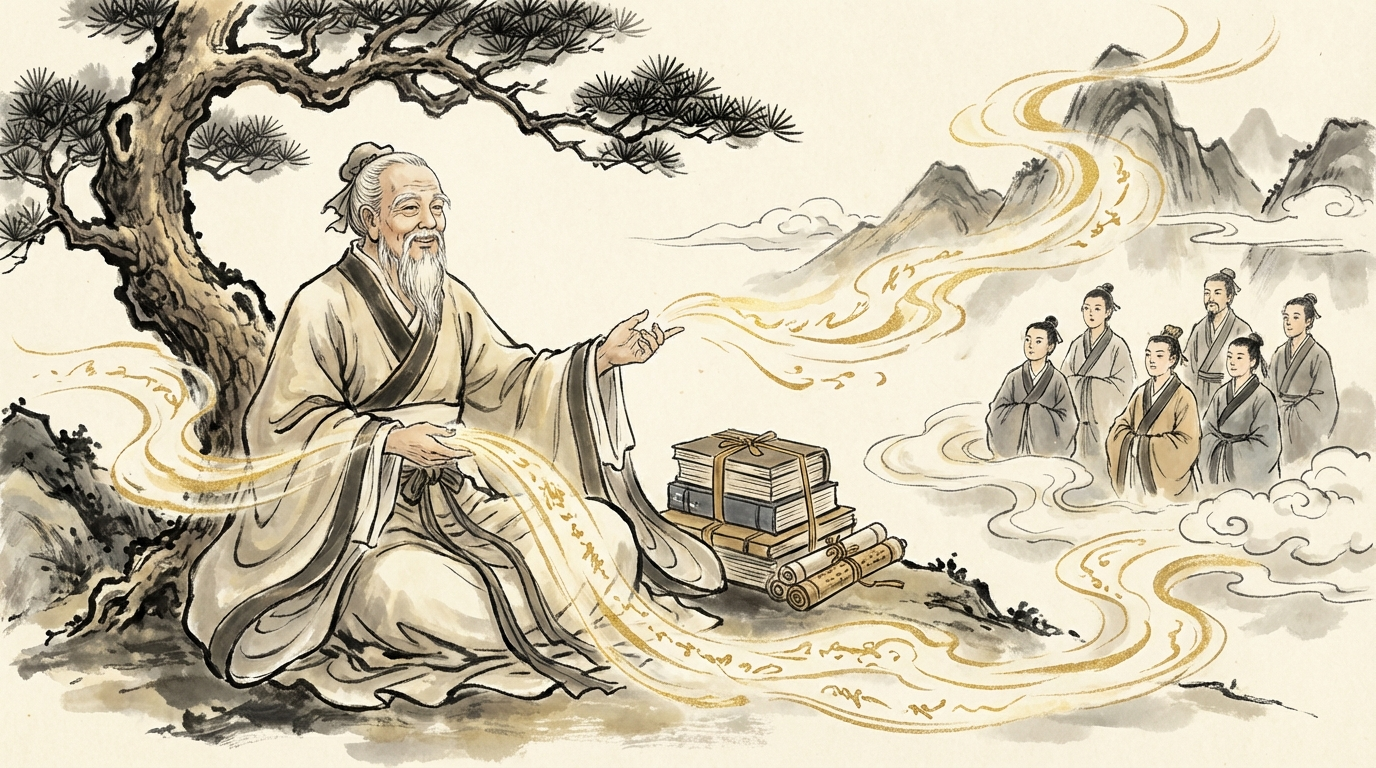
Zheng Yin (正印, zhèng yìn), known as Direct Resource or the Seal, is one of the Ten Gods (十神, shí shén) in BaZi (八字, bāzì). It is the element that produces the Day Master (日主, rì zhǔ) with matching polarity, representing learning, nurturing support, the mother figure, academic credentials, knowledge, and benefactors. Zheng Yin is one of the most auspicious stars in BaZi, especially for intellectual and academic pursuits.
This article is part of our Ten Gods series. New to BaZi? Start with the complete Ten Gods guide for an overview.
Think about the best teacher you ever had. Not the strictest one, not the one who gave easy grades, but the one who actually made you smarter. Who sat with you when you were stuck and explained things in a way that finally clicked. Who believed in you before you believed in yourself. Who never made you feel stupid for not knowing something.
That teacher probably had strong Zheng Yin (正印, zhèng yìn) energy. And if you recognized yourself in that description, you probably do too.
Zheng Yin, the Direct Resource, is the Ten God (十神) that governs knowledge, wisdom, nurturing, and the quiet power of being someone others can lean on. It's not flashy like Pian Guan (七杀). It's not sharp like Shang Guan (伤官). It's the warm light in the library. The hand on your shoulder when you're about to give up. The voice that says "here, let me show you another way."
Curious about your Ten Gods profile? Get your free BaZi reading and see which stars shape your chart.
What is Zheng Yin?
In the Ten Gods system, Zheng Yin is the element that produces your Day Master (日主), with the opposite polarity.
If you're a Yang Wood (甲木) Day Master, Water produces Wood. Yin Water (癸水) has the opposite polarity. That's your Zheng Yin. It feeds you, nourishes you, and strengthens you. Of all the Ten Gods, Zheng Yin is the most directly supportive of your core identity.
"Yin" (印) means "seal" or "stamp." In ancient China, your official seal represented your authority, your credentials, your legitimacy. Zheng Yin is the stamp of approval, the credential, the qualification. It's why this star connects so strongly to education, credentials, and traditional learning.
In classical BaZi, Zheng Yin represents the mother. The logic is intuitive: your mother is the person who produced you, nourished you, and gave you the foundation to exist. Whether or not your actual mother fits this archetype, the energy of Zheng Yin is maternal in the best sense: protective, nurturing, and oriented toward your growth.
The personality of Zheng Yin people
When Direct Resource dominates a chart, you get someone who values knowledge deeply and shares it generously. These people make the world a smarter, kinder place.
You're a lifelong learner
Zheng Yin people collect knowledge the way others collect shoes or watches. You read. You study. You take courses. You go down rabbit holes on topics that have nothing to do with your job, just because the topic is interesting. Your bookshelf is ridiculous. Your browser tabs are a graveyard of unfinished research.
This isn't academic ambition or career development. It's genuine curiosity. You learn because learning feels good, the way exercise feels good to athletes. A day without learning something new feels wasted to you.
The knowledge you accumulate tends to be structured and traditional. You respect established methodologies, peer-reviewed research, time-tested frameworks. You're not drawn to fringe theories or unproven ideas (that's more Pian Yin (偏印) territory). You want the real stuff, taught by people who've earned the right to teach it.
Nurturing is your default mode
You take care of people. Not because you're trying to be helpful, but because it's your automatic response to someone struggling. A colleague can't figure out the report? You sit down and walk them through it. A friend's kid needs tutoring? You volunteer before anyone asks. Your neighbor is going through a rough patch? You show up with food.
This nurturing extends beyond people. You're the one watering the office plants, feeding the neighborhood cats, maintaining traditions that nobody else remembers. There's a caretaking instinct in you that's always running, quietly making the world around you a little better.
Humility comes naturally
Zheng Yin people don't brag. Even when they're the smartest person in the room (which is often), they downplay their knowledge. "I read something about that once" from a Zheng Yin person usually means "I've studied this extensively and can give you a graduate-level lecture on it, but I don't want to make you feel bad."
This humility is genuine, not performed. You actually believe other people probably know more than you. Your response to a compliment about your intelligence is usually "oh, I just read a lot." Imposter syndrome is a constant companion, even when the evidence of your competence is overwhelming.
The shadow side: passive dependence
Zheng Yin energy, when unchecked, can create a person who is intellectually rich and practically poor.
You might become so focused on learning that you never act on what you've learned. Endless preparation for a career move that never happens. Perpetual student syndrome. Another certification, another degree, another course, all stalling the moment when you actually have to put yourself out there and risk failure.
There's also a pattern of waiting for approval. Zheng Yin people need permission, validation, and encouragement before they feel ready to act. Without a mentor figure or authority saying "you're ready," you might never feel ready. You've internalized the student role so deeply that graduation feels impossible.
The other shadow is absorbing other people's problems. Your nurturing instinct doesn't have an off switch. You take on friends' emotional burdens, colleagues' work stress, family members' crises, and over time you become depleted. You're so busy feeding others that you forget to feed yourself.
Zheng Yin in your career
Where you flourish
Education and academia. Teaching, research, curriculum development, academic administration. Zheng Yin people are natural educators. Not just competent ones, beloved ones. Students remember you decades later because you changed how they think.
Writing and publishing. Books, journals, educational content, textbooks. You excel at turning complex knowledge into accessible language. The patience required for long-form writing, research-heavy content, and editorial work suits your temperament perfectly.
Healthcare (the nurturing side). Not surgery (that's Pian Guan). The caring side: nursing, therapy, counseling, social work, palliative care. Any role where your primary function is supporting someone's wellbeing through knowledge and compassion.
Libraries and information management. Organizing, preserving, and sharing knowledge. Archivists, librarians, knowledge managers, database designers. Your reverence for information and your instinct to make it accessible combine perfectly in these roles.
Spiritual and philosophical guidance. Religious leadership, philosophical counseling, meditation teaching, spiritual direction. Your connection to traditional wisdom and your genuine compassion make you a natural guide for people seeking meaning.
Where you struggle
High-pressure sales. You sell through education, not persuasion. "Let me explain why this is valuable" works in some markets. But fast-closing, aggressive sales environments want pressure, not patience. You'll underperform because you can't push someone into a decision they haven't thought through.
Startup chaos. Ambiguous roles, changing priorities, the need to act without complete information. You want to study the problem thoroughly before acting. Startups want you to act now and study later. This mismatch creates anxiety.
Competitive, zero-sum environments. Trading floors, litigation, competitive sports management. Your instinct is to collaborate and teach, not to compete and win at someone else's expense. You can compete when necessary, but it drains you in a way that collaborative work doesn't.
Your career potential depends on your complete chart. Get your free BaZi reading for personalized career insights.
Zheng Yin in relationships
How you love
Supportively and patiently. You're the partner who listens without interrupting, remembers the small things, and provides steady emotional support through every storm. Your love language is understanding. You study your partner the way you study everything: thoroughly, attentively, and with genuine interest.
You bring intellectual depth to relationships. Conversations with you go somewhere. You share interesting ideas, ask thoughtful questions, and help your partner see things from new angles. Over time, people who are in relationships with Zheng Yin people report feeling smarter, more curious, and more reflective. Your influence elevates.
Challenges in love
You might mother your partner. There's a line between nurturing and smothering, and Zheng Yin people cross it regularly. You're so accustomed to taking care of people that you might treat an adult partner like a student or a child. Unsolicited advice. Gentle corrections. "Have you thought about...?" on repeat. This can feel condescending to a partner who wants an equal, not a teacher.
You may avoid passion in favor of stability. Your ideal relationship is comfortable, intellectual, and secure. Which is fine, except sometimes your partner needs heat, spontaneity, or a good fight to clear the air. Your instinct to smooth things over can leave important emotions unexpressed.
You give too much and don't ask for enough. This is the big one. You pour your energy into supporting your partner and forget that you also need support. Over years, this creates an imbalanced dynamic where you're the giver and they're the receiver, and eventually you resent it even though you created the pattern.
Best matches
Partners with Shang Guan (伤官) energy are the classic match. You provide the wisdom and grounding they need. They provide the intellectual fire and creative energy that prevents your life from becoming too quiet.
Zheng Yin in different pillars
Year Pillar
Zheng Yin in the Year Pillar suggests a supportive, educated family background. Parents or grandparents who valued learning, bought you books, and encouraged your curiosity. This is one of the strongest indicators of early academic advantage.
Month Pillar
Direct Resource at full power. Career success through knowledge, education, and traditional qualifications is strongly indicated. Degrees, certifications, and institutional recognition come relatively easily. This placement is common in professors, doctors, researchers, and senior professionals in knowledge-intensive fields.
Day Pillar (Spouse Palace)
Zheng Yin here suggests a partner who is nurturing, intelligent, and supportive of your growth. The relationship provides intellectual companionship and emotional security. Your partner may be older, wiser, or more educated, embodying the mentor-nurturer archetype.
Hour Pillar
Zheng Yin in the Hour Pillar indicates that later life will be characterized by wisdom, learning, and the satisfaction of mentoring others. Your children may be academic achievers. Your retirement will likely involve continued study, writing, or teaching.
When Zheng Yin is too strong
Excessive Resource energy, ironically, creates weakness.
Over-protection breeds passivity. When everything is given to you (support, knowledge, approval), you never develop the muscle to get it yourself. Too much Zheng Yin can create a person who is deeply knowledgeable but incapable of independent action. The eternal student who never graduates.
Analysis paralysis. You have so much information that decision-making becomes impossible. Every choice has too many variables. You need to research more, study more, consult more experts. Meanwhile, life passes by.
Energy drain from over-nurturing. You give until you're empty and then wonder why you feel exhausted, resentful, and invisible. Your boundaries are nonexistent because saying no feels like abandoning someone who needs you.
Intellectual arrogance disguised as humility. This is a subtle one. You say "I don't know much," but you silently judge people who haven't read what you've read. Your humility has a footnote that reads: "I'm modest, but I'm obviously right." This alienates people who sense the disconnect.
The remedy: strengthen output stars like Shi Shen (食神) or Shang Guan (伤官), which channel your accumulated knowledge into productive expression. Stop absorbing and start producing.
When Zheng Yin is weak or absent
Without Zheng Yin, you may lack a support system. Learning comes harder, not because you're less intelligent, but because you don't have natural access to mentors, institutions, or traditional educational pathways. You're self-taught by necessity, which builds independence but can leave gaps.
Weak Zheng Yin people sometimes distrust established knowledge. Not in the sharp, questioning way of Shang Guan, but in a detached way. "School never worked for me." "Books can't teach real experience." While there's truth in these sentiments, they can also block you from resources that would genuinely help.
Zheng Yin vs. Pian Yin
Zheng Yin is the university. Pian Yin (偏印) is the midnight bookshop that only opens on Tuesdays.
Zheng Yin is traditional knowledge. Pian Yin is unconventional wisdom.
Zheng Yin supports you openly and consistently. Pian Yin supports you unpredictably and sometimes pulls the rug out.
Zheng Yin creates stable scholars. Pian Yin creates eccentric geniuses.
Both produce brilliant people. The texture of that brilliance is different.
How to work with Zheng Yin energy
Act on what you know. You've accumulated enough knowledge. It's time to use it. Write the book. Teach the class. Start the practice. Launch the thing. Your preparation is already more than sufficient. What you need now is courage, not more information.
Set boundaries on your nurturing. You can't take care of everyone. Pick the people who genuinely need and deserve your support, and give them your full attention. Let everyone else figure it out. This isn't selfish. It's sustainable.
Find your own mentors. Zheng Yin people are great mentors for others but often neglect finding mentors for themselves. You need someone who challenges you, guides you, and holds you accountable the same way you do for others. Look for that person and let them help.
Balance learning with doing. For every book you read, take one action. For every course you complete, implement one lesson. Create a rule: no new input until you've acted on the last input. This prevents the knowledge hoarding that keeps Zheng Yin people stuck.
Frequently asked questions
Is Zheng Yin always positive? Mostly, but not entirely. Strong Zheng Yin provides knowledge, support, and credentials. Excessive Zheng Yin creates passivity, dependence, and overthinking. Like all Ten Gods, balance is what matters.
Does Zheng Yin mean I'll be a good student? Usually yes. Zheng Yin people naturally thrive in educational environments, absorb information easily, and earn academic credentials. But "good student" doesn't automatically mean "successful person." You also need the drive to apply what you learn.
What's the relationship between Zheng Yin and the mother? In classical BaZi, Zheng Yin represents the mother or maternal figure. It reflects the nurturing, educational, and protective influence of whoever raised you. A strong Zheng Yin often correlates with a supportive maternal relationship, while a weak or afflicted Zheng Yin may suggest challenges in that area.
Can Zheng Yin people be leaders? Absolutely. Zheng Yin leadership is the mentor-leader style: leading by example, developing people, and building knowledge-based organizations. Think university deans, hospital directors, think tank founders. It's not the charismatic command style, but it's profoundly effective.
Your next step
Zheng Yin shows your relationship with knowledge, support, and the nurturing energies in your life. But it's just one piece of a complex puzzle. How it interacts with your output stars, wealth stars, and officer stars creates the full picture.
Get your free BaZi reading now to discover how Zheng Yin works alongside the rest of your Ten Gods and find where your wisdom can take you.
Explore more Ten Gods: Pian Yin (Indirect Resource) | Shang Guan (Hurting Officer) | Shi Shen (Eating God) | Zheng Guan (Direct Officer)