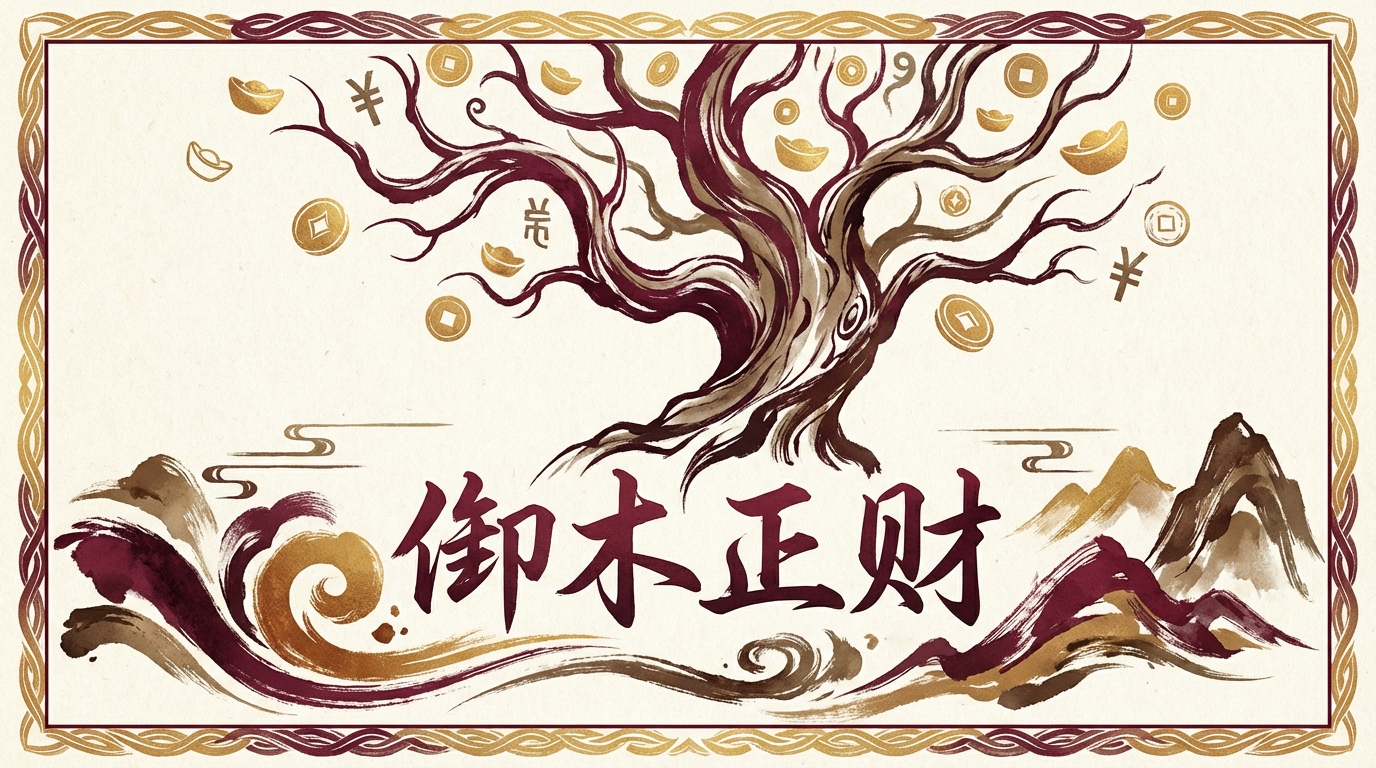
A tree in a well-tended orchard produces reliable fruit. Not the dramatic treasure that comes from finding a mineral vein in wild terrain — but season after season, the carefully managed tree yields what it promises. The farmer knows what to expect. The roots go down into prepared soil. The investment of time and care comes back in kind.
Zheng Cai (正财, zhèng cái), Direct Wealth, for Jia Wood is Ji Earth (己土, Yin Earth) — the cultivated garden soil, the tended field, the earth that rewards methodical care. Where Pian Cai (偏财) is the vast mountain terrain full of potential but requiring opportunistic skill, Zheng Cai is the carefully prepared ground. You know how to work it. You know what it produces. You can count on it.
Part of the Day Master × Ten God series. See also: Jia Wood Day Master and Zheng Cai overview.
What Zheng Cai Means for Jia Wood
In BaZi (八字), Zheng Cai (正财) is the Direct Wealth star — the Earth element that the Day Master controls with opposite polarity. For Jia Wood, Wood controls Earth, and opposite polarity gives us Ji Earth (己土, Yin Earth).
The relationship of Jia Wood to Ji Earth is precise and revealing. Ji Earth is the soft, fertile, cultivated soil — the kind of earth that yields abundantly to patient, systematic care. Jia Wood's roots penetrate it deeply, drawing out nutrients steadily rather than in great surges. This is the quality of Direct Wealth: the resources that are accessed through consistent effort over time, through systems and processes that reliably deliver, through the kind of financial discipline that doesn't produce dramatic results in any single year but builds something solid and lasting.
Compare this to Pian Cai (偏财), which for Jia Wood is Wu Earth — the mountain range, the vast uncontrolled terrain. Pian Cai offers bigger peaks and bigger troughs. Zheng Cai offers steadier, more predictable, more accountable wealth. The orchard versus the goldmine.
For Jia Wood — a Day Master with genuine ambition that can sometimes outpace its patience — Zheng Cai introduces a balancing quality: the recognition that wealth is often built not through a single extraordinary find, but through the sustained, systematic cultivation of what you've already got.
How This Shows Up in Your Personality
Methodical and financially accountable
Jia Wood people with strong Zheng Cai have a quality of financial accountability that's often their most reliable professional characteristic. They track things. They know where the money is and where it came from. They build systems — sometimes imperfect, but always present — for managing the resources in their care.
This isn't the flashy financial intelligence of the speculator. It's the less glamorous but more durable intelligence of the steward: knowing what you have, managing it carefully, not being surprised by the numbers at year end because you've been watching them all along.
I worked with a Jia Wood client who had Ji Earth in her hour pillar, creating a strong Zheng Cai dynamic. She was a financial manager in her forties who had quietly built more wealth than most of her higher-earning colleagues. Her approach was not complicated: "I just never spend the first deployment of money," she said. "I wait to see how the situation actually develops, then commit. Usually a lot of what looks necessary in the moment turns out to be avoidable." This is Zheng Cai operating cleanly.
The long view on accumulation
Zheng Cai Jia Wood people tend to have a genuine preference for compounding over one-time gains. Not because they lack the vision for larger plays — often they have it — but because the steady accumulation of reliable returns over decades is both more emotionally satisfying and more consistent with how they're wired.
This creates patience that can frustrate people around them. They don't rush into investments. They're skeptical of opportunities that promise rapid returns. They'd rather have the 7% annual compound than the 30% chance at 50%. This is not conservatism for its own sake — it's a clear-eyed read on which approach actually builds wealth over time for their specific temperament.
Control as a form of care
In a broader sense, Zheng Cai energy creates a quality of considered control over resources — not just financial, but material and relational. Jia Wood Zheng Cai people tend to manage what's in their care carefully. Their homes are maintained. Their finances are tracked. The things they're responsible for don't fall into disarray.
This quality of careful stewardship extends to relationships. They tend to be reliable partners — present, consistent, following through on commitments — in ways that are often taken for granted but would be deeply missed if absent.
The patience that sometimes frustrates ambition
One friction point worth naming: Jia Wood's natural ambition can sometimes be in tension with Zheng Cai's methodical approach. The tall tree wants to reach the light quickly. Zheng Cai keeps asking: have you prepared the soil adequately? Are the systems in place? Can the current infrastructure support the growth you're planning?
This tension is productive when it leads to better-prepared leaps. It becomes a problem when the methodical temperament prevents taking genuinely good opportunities because they don't fit the established process. Knowing the difference between appropriate due diligence and excessive caution is ongoing self-management.
Career Implications
Where Jia Wood Zheng Cai thrives
Finance and wealth management. The combination of Jia Wood's strategic intelligence and Zheng Cai's systematic approach to managing resources creates a natural profile for finance careers. Not necessarily trading (which has more Pian Cai character) but wealth management, private equity, institutional asset management, financial planning — environments where the sustained, disciplined management of significant resources over long periods is the actual work.
Business operations and administration. The Chief Operating Officer role is a classic expression of this combination: strategic enough to see the larger picture (Jia Wood) while patient and methodical enough to build the systems that actually make the business run (Zheng Cai). The person who translates vision into sustainable operations.
Real estate development and property management. Long-term projects with patient capital investment that yields predictable returns over decades — the rhythm of real estate suits Zheng Cai's character well. Not the speculative flipping (which is more Pian Cai) but the long-hold, steady-yield, patient-accumulation approach.
Accounting, auditing, and financial control. The systems orientation of Zheng Cai makes for excellent financial controllers and auditors — people who are genuinely good at knowing where the resources are, tracking how they move, and ensuring the systems that manage them are reliable.
Supply chain and resource management. Any field where the work is fundamentally about managing the flow of physical or financial resources through reliable systems — logistics, procurement, inventory management — suits this configuration well.
For more on navigating career choices through BaZi, see our career guide.
Where friction arises
High-velocity trading and speculative investing. The fast-moving, high-variance world of speculation requires a different relationship with uncertainty than Zheng Cai provides. This doesn't mean Jia Wood Zheng Cai people can't engage with markets — it means the slow-and-steady, fundamentals-based approach is more likely to produce good outcomes than trying to force the Pian Cai pattern.
Roles with very long feedback loops. While Zheng Cai is patient in accumulation, there's still a requirement for the systems to produce visible output. Roles where years pass before any results materialize — and where the reliable yield of the tended soil never quite comes — can be genuinely demoralizing.
Environments where the financial discipline is irrelevant. Some organizations run on chaotic financial management where accountability is structurally impossible. The Zheng Cai quality that makes for excellent stewardship has nowhere to land in these environments, creating sustained frustration.
Relationship Dynamics
Zheng Cai in a man's chart: the partner connection
In classical BaZi, for male charts, wealth stars are traditionally associated with the romantic partner or spouse. Zheng Cai specifically — with its patient, reliable, cultivated character — is associated with the steady, committed partner: someone who grows the relationship the same way you'd tend a garden, with consistent care over time.
This often manifests as a preference for partners who are dependable over partners who are exciting. Not that Jia Wood Zheng Cai men find dependability boring — they find it genuinely reassuring in a way that some other configurations don't. The reliable harvest is more valuable than the spectacular occasional find.
The provider orientation
Jia Wood Zheng Cai people often carry a strong provider orientation — not in an old-fashioned sense, but in the sense of genuinely caring about the financial security of the people they're close to and taking active responsibility for contributing to it. Managing the household finances, planning for the long term, making sure the systems are in place — this feels like an expression of care, not an obligation.
The shadow side is when the provider orientation becomes a way of avoiding emotional intimacy. "I'm taking care of everything financially" can be a substitute for presence, for vulnerability, for the kinds of conversation that require something other than material competence. Worth monitoring.
Stability as the foundation of trust
In all close relationships, Jia Wood Zheng Cai people tend to build trust through demonstrated consistency rather than through emotional intensity. They show up, week after week, following through on what was agreed, managing the material dimension of the relationship with care. This builds a kind of deep trust over time that is different from — and often more sustaining than — the trust that comes from shared intense experiences.
Partners who are nourished by this kind of consistency will value it enormously. Partners who primarily experience love through spontaneity and emotional fireworks may feel undernourished even when they're objectively well-cared for.
Luck Cycle Interactions
When Ji Earth (or other Yin Earth influences) enters your 10-year luck pillars (大运) or annual pillars (流年):
Strengthened capacity for systematic accumulation. This is one of the best periods for the patient, disciplined building of wealth. Not the windfall luck of Pian Cai periods — but the steady, compounding building of a reliable base.
Career advancement through demonstrated competence. Zheng Cai luck tends to reward the financial stewardship that has been quietly building. Promotions, recognition, and expanded responsibility in financial or operational domains become more available.
Relationship stability and deepening commitment. Zheng Cai luck periods often bring relationship milestones: formalization of long-term relationships, buying property together, decisions to build a family — the practical manifestations of sustained commitment.
Clarity on financial systems. What needs to be tracked, what's working, what's leaking resources — these become more visible. This is an excellent period for financial reviews, for building the systems that will serve you over the next decade.
Watch for excessive conservatism. The shadow side of strong Zheng Cai luck is overcorrection into conservatism — missing genuinely good opportunities because the methodical temperament becomes too dominant. The prepared soil is an asset; refusing to plant because the conditions aren't absolutely perfect is not.
For a complete understanding of how luck cycles affect Jia Wood, see the Jia Wood Day Master guide.
Practical Advice
Build your financial systems early and maintain them. Zheng Cai rewards the people who have the systems in place before they need them. Tracking spending, maintaining an investment plan, having clear financial goals — these aren't exciting, but they're what the orchard requires. The patient investment in systematic care is where your financial strength actually comes from.
Resist the urge to reach for Pian Cai gains when your strength is Zheng Cai. When everyone around you seems to be making spectacular returns from speculative plays, the temptation to abandon what works for you in favor of what's working for someone else is real. Your financial intelligence is suited to a different pattern. Trust it.
Use your long-view orientation to make decisions that shorter-term thinkers miss. Where others see a 3% annual yield as boring, you see 25 years of compounding. This perspective — genuinely less common than it should be — is a competitive advantage when deployed in contexts that reward it.
Don't let financial competence substitute for emotional presence. The care expressed through managing resources reliably is real and valuable. It doesn't fully substitute for showing up emotionally, being present, having the hard conversations. Both are needed.
Identify where your accumulation is leaking. Zheng Cai people often have one or two places where resources disappear in ways they don't fully account for — an area where the tended soil is less tended than the rest. Finding and addressing those leaks produces disproportionate results.
FAQ
What is Zheng Cai for Jia Wood in BaZi?
Zheng Cai (正财), Direct Wealth, for Jia Wood Day Masters is Ji Earth (己土, Yin Earth) — the Earth element that Jia Wood controls with opposite Yin polarity. In the Ten Gods system, Zheng Cai represents direct, reliable, cultivated wealth: the financial returns that come through patient systems, methodical effort, and consistent management rather than opportunistic finds. For Jia Wood, it's the carefully tended orchard soil — fertile, reliable, yielding steadily to those who work it well. Get your free reading to see where Zheng Cai appears in your chart.
How does Zheng Cai differ from Pian Cai for Jia Wood?
Pian Cai (偏财) for Jia Wood is Wu Earth (戊土, Yang Earth) — the vast mountain terrain, unconventional wealth through entrepreneurship, investment, and opportunistic timing. It produces larger peaks and larger troughs. Zheng Cai for Jia Wood is Ji Earth (己土, Yin Earth) — the cultivated garden soil, wealth through patient systematic accumulation, reliable processes, and steady compounding. Pian Cai rewards vision and risk tolerance; Zheng Cai rewards discipline and consistency. Both are wealth stars — but they call for very different approaches and produce very different patterns. Most charts have elements of both; the question is which is stronger and better supported.
Is Zheng Cai good for Jia Wood?
Yes — Zheng Cai is one of the most constructive wealth configurations in BaZi for any Day Master. It doesn't produce the dramatic windfall stories that Pian Cai does, but it produces something arguably more valuable: durable, compounding wealth that grows reliably over time. For Jia Wood specifically, Zheng Cai provides the patient, methodical financial intelligence that complements the Day Master's natural ambition. The main caution: excessive Zheng Cai without balancing elements can lead to overcaution — the orchard is perfectly tended but the farmer is too careful to harvest.
Ready to understand exactly where Zheng Cai sits in your chart and how it shapes your relationship with money, work, and the long game of wealth building? Get your free BaZi reading and discover your complete wealth profile.