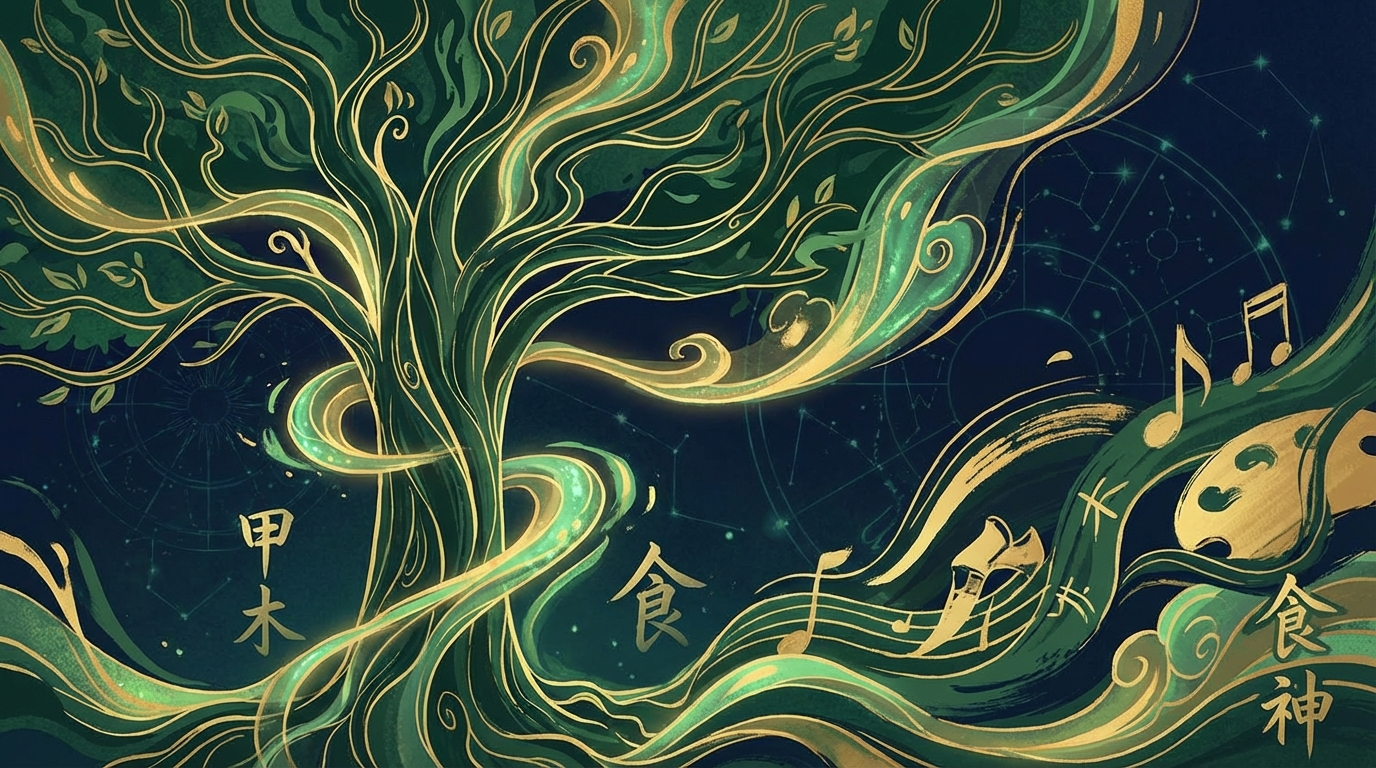
Picture the hearth fire in a long-established house. It doesn't blaze dramatically. It doesn't consume the structure around it. It burns steadily, warmly, casting its light over a comfortable room where people gather naturally — to eat well, to talk, to rest from the larger world. The tree that feeds this fire is not being sacrificed. It's fulfilling one of its best purposes.
Shi Shen (食神, shí shén), the Eating God, for Jia Wood is Ding Fire (丁火, Yin Fire) — the candle flame, the steady hearth, the warm lantern light. It is the controlled, sustaining expression of the wood's energy: generative rather than consuming, nourishing rather than challenging, abundant in the quiet way that the best things often are.
Part of the Day Master × Ten God series. See also: Jia Wood Day Master and Shi Shen overview.
What Shi Shen Means for Jia Wood
In BaZi (八字), Shi Shen (食神) is the Eating God — the element the Day Master produces with the same polarity. For Jia Wood, Wood produces Fire, and same polarity gives us Ding Fire (丁火, Yin Fire).
To understand what this means, contrast it with Shang Guan (伤官), the Hurting Officer, which for Jia Wood is Bing Fire (丙火, Yang Fire). Bing Fire is the sun — brilliant, vast, radiant, and its relationship with authority is directly adversarial: it weakens Zheng Guan (正官). Ding Fire is the candle or the hearth: contained, steady, intimate. It illuminates the room without challenging the house.
Shi Shen is classically one of the most favorable stars in BaZi. It is sometimes called the "longevity star" because it represents sustained, healthy output — the Day Master expressing itself in ways that are generative rather than depleting. It's associated with food and pleasure (hence "Eating God"), with creative work done for the enjoyment of the process, with the natural overflow of a well-nourished system rather than the forced output of a straining one.
For Jia Wood — ambitious, direct, oriented toward significant achievement — Shi Shen introduces the quality of ease: the recognition that the best creative and productive output often comes not from forcing the tree to produce, but from ensuring it is so well-nourished that production becomes natural overflow.
How This Shows Up in Your Personality
The natural abundance of the well-fed tree
Jia Wood Shi Shen people have a quality of creative generosity that is notably different from the strategic output of other configurations. They produce because it's natural, because the energy wants to flow, because the tree is full and the output is overflow. There's no scarcity mentality here. They share ideas freely, create without hoarding, give their time and energy to things they care about without carefully measuring the return.
This generosity is genuine and tends to attract abundance in return — not because they're calculating, but because people and opportunities naturally gather around the warmth. The hearth draws people. Those who come and are nourished tend to stay.
The sensory and aesthetic intelligence
Ding Fire is warm, intimate, and beautifully specific. Shi Shen for Jia Wood people creates a heightened sensory and aesthetic intelligence — a genuine attentiveness to the quality of experience, to what makes things good rather than merely adequate.
This shows up across domains: in the care given to a meal, the way they notice when something is beautifully made, the attention to craft in their own work. There's often a quality of connoisseurship that isn't snobbish — they're not interested in status symbols — but that involves genuine discrimination between things done well and things done carelessly.
I often notice Shi Shen people have a particular relationship with food, specifically: they notice flavors, they care about the quality of what they're eating, they're the friend who knows where the good restaurants are. This is not trivial — it's an expression of the same sensory intelligence that makes them perceptive in creative and professional domains.
The slow production style that others may misread
Jia Wood Shi Shen people often produce in a way that can be misread as leisurely or unmotivated. The output is steady but unhurried. They don't push. They don't strain. They wait for the conditions to be right, then produce with a naturalness that doesn't look like effort even when it is.
This is not laziness — it's efficiency of a specific kind. The well-nourished tree doesn't need to be forced. The pressure that drives other configurations comes more naturally here as absorption and readiness than as willpower and exertion. The work gets done when the conditions support it, and the work is usually better for not having been forced.
The difficulty is in environments that reward visible effort over quality output, or that measure productivity by hours of apparent struggle rather than by results. In those environments, Shi Shen people often appear less productive than they are.
The contentment that resists ambition
One of the more complex aspects of Shi Shen for a Day Master as naturally ambitious as Jia Wood: the contentment that Shi Shen brings can sometimes be enough. The hearth is warm, the meal is good, the work is satisfying — why reach beyond this?
Jia Wood's nature wants to grow, to reach, to achieve at scale. Shi Shen's nature wants to be content, to enjoy, to produce from a place of fullness rather than hunger. When both are present and balanced, they create someone who is genuinely productive and genuinely at peace with their productivity. When Shi Shen becomes dominant, the ambition can become muted in ways the person may not notice until they're in their forties wondering why they didn't reach further.
This isn't necessarily a problem — a deeply satisfying life of steady, good work is not a failure. But it's worth examining occasionally: is the contentment genuine fulfillment, or is it ease masquerading as satisfaction?
Career Implications
Where Jia Wood Shi Shen thrives
Artisan and craft domains. Work where the process is as valued as the product — furniture-making, culinary arts, glasswork, pottery, traditional craft of any kind. The patience, the sensory intelligence, the pleasure in the work itself, and the indifference to shortcuts that Shi Shen brings all align with the demands of genuine artisanship.
Creative content and media. Writing, podcasting, filmmaking, music composition — creative work that requires sustained output over long periods, that benefits from a non-forced production style, and that relies on genuine sensory and aesthetic intelligence to distinguish excellent work from adequate work. The Shi Shen quality of producing from fullness rather than strain tends to be visible in the output.
Culinary and hospitality industries. The food connection of "Eating God" is not accidental. Cooking, running restaurants, hospitality management, food writing, sommelier work — any domain where the ability to notice and create quality sensory experiences is the professional competence.
Teaching and mentorship. The natural generosity and the sustained, warm output of Shi Shen make for exceptional teachers — people who genuinely enjoy the process of helping someone else develop, who share their expertise without calculation, who create the kind of learning environment where students feel nourished rather than pressured.
Long-form research and writing. Academic work, investigative journalism, book-length projects — work that requires sustained attention over long periods, that benefits from a non-urgent production style, and where the quality of thinking matters more than the speed of output.
For more on BaZi and career choices, see our career guide.
Where friction arises
High-urgency, high-pressure delivery environments. The natural production rhythm of Shi Shen doesn't respond well to sustained external pressure. The forced output tends to be less good than the natural output, and the effort required to force it creates a specific kind of depletion that takes longer to recover from than ordinary fatigue.
Competitive environments that require aggressive self-promotion. Shi Shen people often have difficulty with the aspects of professional advancement that require actively claiming visibility and credit. The generosity that makes them excellent producers can mean the fruits of their work get attributed elsewhere or simply not attributed at all.
Roles where the work is purely transactional. Output for its own sake, without any dimension of craft or sensory engagement, depletes Shi Shen energy in a way that output connected to genuine quality does not. The Eating God needs to be fed in return.
Relationship Dynamics
The nourisher and the nourished
Jia Wood Shi Shen people tend to create relationship environments that are genuinely nourishing — in the literal sense of being generous with food, comfort, and material care, and in the broader sense of creating spaces where others feel well-received. Their homes are often places people want to gather. Their presence tends to create ease.
This is a profound relational gift. It is not always equally reciprocated. Shi Shen people sometimes find themselves in relationships where they're providing the nourishment without receiving much in return — not through exploitation, but through an imbalance of giving and receiving that can become habitual.
The non-confrontational quality in close relationships
Shi Shen's contentment and non-challenging nature means Jia Wood Shi Shen people tend not to be naturally confrontational in close relationships. They prefer to manage friction through comfort — a good meal, a quiet evening, a shift in atmosphere — rather than through direct address of the issue.
This works well for minor friction. For significant issues that require direct address, the avoidance can become a problem. The hearth keeps burning pleasantly even when the house has structural issues that need attention.
Shi Shen and the partner dynamic
In classical BaZi, Shi Shen has a traditional association with children and fertility — the natural output of the Day Master in its most sustaining form. At a psychological level, this also connects to the Shi Shen person's inclination toward nurturing, toward creating conditions where others can grow and flourish.
In romantic partnerships, this tends to manifest as genuine investment in the partner's wellbeing and development — not the strategic provider orientation of Zheng Cai or the passionate protection of Pian Guan, but something quieter and more pervasive: the consistent creation of conditions where the partner can be their best self.
Luck Cycle Interactions
When Ding Fire (or other Yin Fire influences) enter your 10-year luck pillars (大运) or annual pillars (流年):
Enhanced creative output quality. Shi Shen luck periods are often when the best work appears — not necessarily the most prolific work, but the work that people remember. The conditions align with the natural production style, and what emerges is notable.
Increased sensory pleasure and quality of life. Strong Shi Shen luck periods tend to be characterized by an increased appreciation for and access to the things that make life genuinely good: good food, beautiful spaces, satisfying work, pleasurable experiences. This is not vanity — it's the Eating God operating as intended.
Natural accumulation of resources. The abundant, generous production of Shi Shen tends to attract material abundance in return — not dramatically, but steadily. Shi Shen luck periods often see gradual but solid improvement in material circumstances.
Watch for complacency. The contentment that Shi Shen brings is real and has real value. But during strong Shi Shen luck periods, the temptation is to simply stay warm by the hearth when the Jia Wood ambition calls for something more. Periodically asking whether the current level of contentment is actually fulfilment, or simply ease, is important self-monitoring.
Children or creative "children." Classically associated with children, Shi Shen luck periods often coincide with new projects that are genuinely yours — work you'll care for and develop the way a parent cares for a child.
For a full view of how luck cycles affect Jia Wood, see the Jia Wood Day Master guide.
Practical Advice
Protect the conditions for natural production. Shi Shen output is best when it emerges naturally rather than under forced conditions. This means protecting the conditions that support it: adequate rest, sensory nourishment, time that isn't over-scheduled, work rhythms that allow absorption before output. These aren't luxuries — they're the soil the hearth requires.
Build in mechanisms for claiming your work. The generosity of Shi Shen means the work often gets shared freely before the credit is established. This isn't wrong — but in professional contexts, it can mean significant contributions go unrecognized. Developing habits for making your authorship and contributions visible is important self-advocacy.
Examine the contentment periodically. The Eating God contentment is one of the genuine gifts of this configuration. But it's worth asking, every few years: is this contentment the satisfaction of a life well-lived, or is it the comfort of a life not fully pursued? The hearth is warm. Is there somewhere you want to go that you haven't yet?
Use the sensory intelligence as a professional asset. The ability to notice quality, to discriminate between things done well and things done carelessly, to evaluate the sensory and aesthetic dimensions of work — this is a rare and genuinely valuable skill in many professional domains. Name it and apply it deliberately.
Don't mistake the production style for a lack of ambition. The unhurried quality of Shi Shen output can be misread — by others and by yourself — as insufficient ambition. It isn't. The scale of what Shi Shen Jia Wood people can build through sustained, quality output over decades is often larger than what forcing the pace would have produced. Trust the style.
FAQ
What is Shi Shen for Jia Wood in BaZi?
Shi Shen (食神), the Eating God, for Jia Wood Day Masters is Ding Fire (丁火, Yin Fire) — the element that Jia Wood produces with the same Yang/Yin polarity. In the Ten Gods system, Shi Shen represents sustained, generous, nourishing output — the creative and productive expression of the Day Master that flows naturally, without straining the source. For Jia Wood, it's the steady hearth fire: the warm, consistent, life-sustaining flame that the wood feeds without being consumed. Get your free reading to see where Shi Shen appears in your chart.
Is Shi Shen good for Jia Wood?
Shi Shen is classically one of the most favorable stars in BaZi, associated with longevity, abundance, and the kind of sustained good output that builds a full life over time. For Jia Wood specifically, it provides the ease and generosity of expression that can make ambitious achievement feel natural rather than forced. The main nuance: for a Day Master as ambitious as Jia Wood, the contentment of Shi Shen needs to be balanced with the forward drive that the Day Master naturally brings. When these elements are balanced, the result is someone who produces excellent work sustainably and enjoys the process of doing so.
How does Shi Shen differ from Shang Guan for Jia Wood?
Shang Guan (傷官) for Jia Wood is Bing Fire (丙火, Yang Fire) — the sun, the bonfire, brilliant and challenging, actively weakening the Zheng Guan (Direct Officer). Shi Shen for Jia Wood is Ding Fire (丁火, Yin Fire) — the candle, the hearth, steady and nourishing, not challenging the Officer star. Both are Output stars, but Shang Guan creates and challenges conventional authority, while Shi Shen creates without challenging. Shang Guan is brighter and more disruptive; Shi Shen is steadier and more sustaining. Classical texts favor Shi Shen for its benign quality; in practice, which serves you better depends heavily on what you're building and in what environment.
Want to know where Shi Shen sits in your chart and how it shapes the way you create, nourish others, and accumulate abundance? Get your free BaZi reading and discover your complete expression profile.