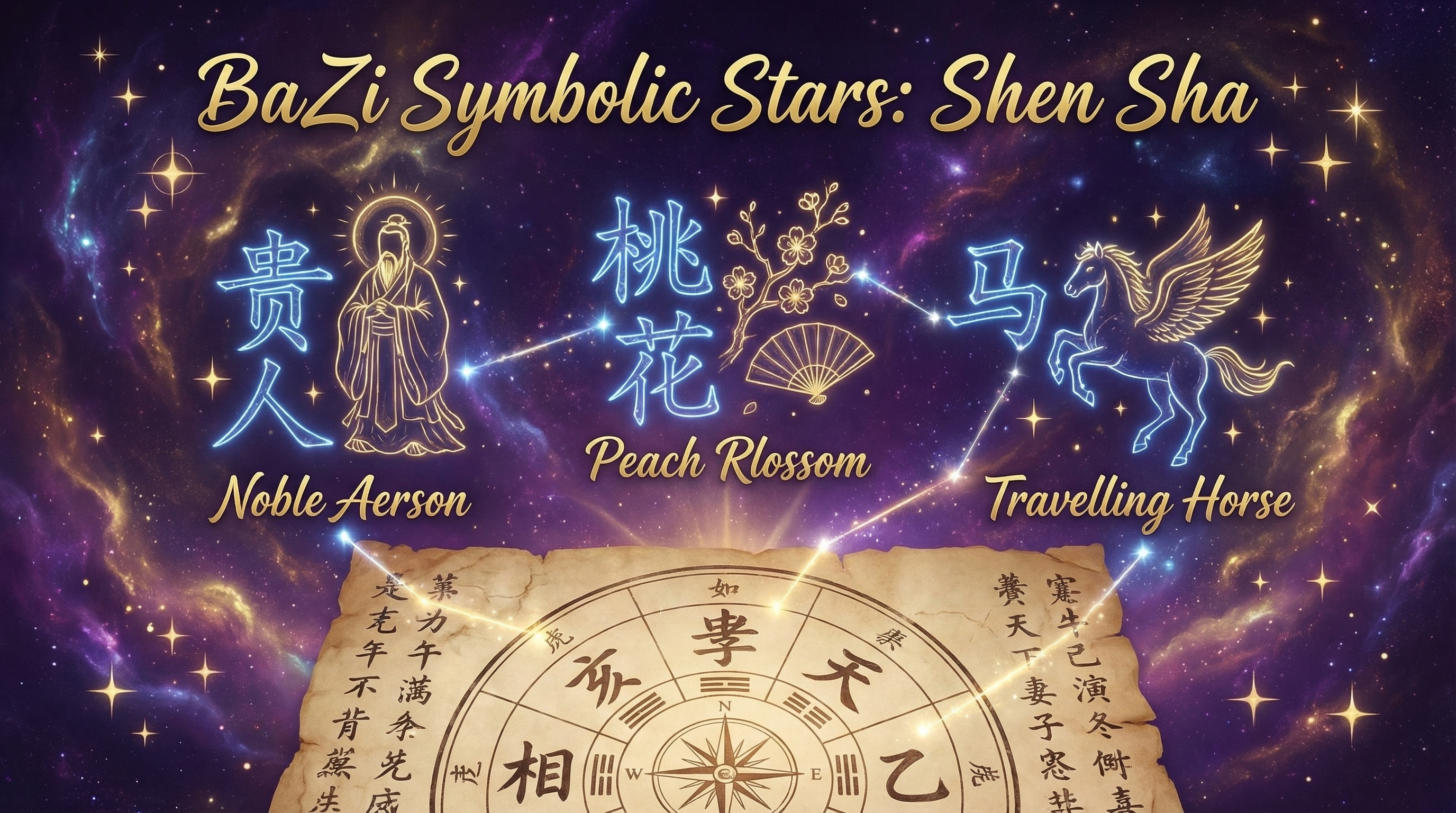
Your BaZi chart tells a story through elements and their relationships. The Ten Gods reveal who shows up in that story: mentors, rivals, wealth sources, creative muses. But there's another layer most beginners overlook, one that classical practitioners have relied on for centuries to add color, specificity, and predictive power to a reading.
Symbolic Stars (神煞, shén shà), also called Shen Sha or auxiliary stars, are special configurations in a BaZi chart derived from specific Heavenly Stem and Earthly Branch interactions. The most important Symbolic Stars include Tian Yi (Noble Person), Tao Hua (Peach Blossom), Yi Ma (Travelling Horse), Wen Chang (Academic Star), and Jiang Xing (General Star). Each reveals hidden talents, tendencies, or life patterns that elemental analysis alone cannot explain.
If the Ten Gods are the main characters in your life's drama, Symbolic Stars are the plot devices: the lucky breaks, the fateful encounters, the hidden talents that surface at just the right moment. They don't replace elemental analysis. They enrich it. And once you learn to spot them, you'll wonder how you ever read a chart without them.
What are Symbolic Stars?
Symbolic Stars are special configurations derived from the interactions between Heavenly Stems and Earthly Branches in your chart. Unlike the Ten Gods, which are calculated purely from elemental relationships with your Day Master, Symbolic Stars come from pattern-matching: specific branch combinations, stem-branch pairings, or positional relationships between your pillars.
Classical BaZi texts catalog over a hundred of these stars. Some are auspicious. Some are cautionary. Many are highly situational. In modern practice, most readers focus on a core set of 15 to 20 that consistently prove meaningful.
Here's what makes them useful: Symbolic Stars answer the questions that elemental analysis alone can't. "Why does this person always land on their feet despite a weak chart?" Maybe they carry the Tian Yi (Noble Person) star. "Why is someone with a perfectly balanced chart constantly restless?" Check for Yi Ma (Travelling Horse).
They're the fine print in the contract your birth chart wrote with the universe.
How Symbolic Stars work
Every Symbolic Star has a derivation rule, a specific formula that determines whether it appears in your chart. Most rules use one of these approaches:
Branch-to-branch mapping. Your Day Branch or Year Branch points to a specific branch elsewhere in your chart. For example, if your Day Branch is Yin (Tiger), your Peach Blossom star is Mao (Rabbit). If Mao appears in any of your four pillars, you carry that star.
Stem-to-branch mapping. Your Day Stem points to a specific branch. For Tian Yi (Noble Person), a Jia (Yang Wood) Day Master looks for Chou (Ox) or Wei (Goat) in the chart.
Positional rules. Some stars depend on where a branch appears, in the Year Pillar versus the Day Pillar, for instance, because the same star can mean different things depending on its position.
The key thing to understand: you don't need to memorize all the derivation tables. A proper BaZi calculator handles the lookup automatically. What you need is interpretive skill, knowing what each star means when it shows up, and how it interacts with the rest of your chart.
Want to see which Symbolic Stars appear in your chart? Try our free BaZi reading. It maps your pillars and highlights the key stars instantly.
The essential Symbolic Stars
Let's walk through the stars that matter most in practical chart reading. For each one, I'll cover what it represents, how to find it, and what it actually looks like in someone's life.
1. Tian Yi Gui Ren, the Noble Person star (天乙贵人)
This is one of the most auspicious stars in all of BaZi. Tian Yi (天乙, tiān yǐ) literally means "Heavenly Second," a reference to the second star in the Big Dipper, which ancient Chinese astronomers associated with divine assistance.
What it means: You attract helpful people. When you're in trouble, someone shows up, a mentor, a stranger, an old contact, and the situation resolves. People with strong Tian Yi energy don't necessarily avoid problems. They just never face them alone.
How to find it:
The Noble Person star is derived from your Day Stem (some practitioners also check the Year Stem):
| Day Stem | Noble Person Branches |
|---|---|
| 甲 (Jiǎ) Yang Wood | 丑 (Ox), 未 (Goat) |
| 乙 (Yǐ) Yin Wood | 子 (Rat), 申 (Monkey) |
| 丙 (Bǐng) Yang Fire | 酉 (Rooster), 亥 (Pig) |
| 丁 (Dīng) Yin Fire | 酉 (Rooster), 亥 (Pig) |
| 戊 (Wù) Yang Earth | 丑 (Ox), 未 (Goat) |
| 己 (Jǐ) Yin Earth | 子 (Rat), 申 (Monkey) |
| 庚 (Gēng) Yang Metal | 丑 (Ox), 未 (Goat) |
| 辛 (Xīn) Yin Metal | 寅 (Tiger), 午 (Horse) |
| 壬 (Rén) Yang Water | 卯 (Rabbit), 巳 (Snake) |
| 癸 (Guǐ) Yin Water | 卯 (Rabbit), 巳 (Snake) |
If either Noble Person branch appears in any pillar of your chart, you carry this star.
In practice: A client with a Ding Fire Day Master had Hai (Pig) in both her Month and Hour pillars, double Noble Person. She'd been laid off three times in her career. Each time, within weeks, someone from her network reached out with an opportunity better than what she'd lost. She called it luck. Her chart called it Tian Yi.
People with multiple Noble Person stars often thrive in professions that depend on relationships: consulting, diplomacy, sales, politics. The star doesn't make you talented. It makes you findable by the right people at the right time.
Watch for: Noble Person stars that sit next to clashing branches. A Noble Person next to a punishment (刑) or clash (冲) formation may indicate that help arrives, but with complications or strings attached.
2. Tao Hua, the Peach Blossom star (桃花)
We've written a detailed guide to Peach Blossom, so I'll keep this focused on how it fits within the broader Symbolic Stars framework.
What it means: Personal magnetism, romantic attraction, artistic sensitivity, social charm. Peach Blossom is the star of allure.
How to find it:
Based on your Day Branch or Year Branch:
| Day/Year Branch Group | Peach Blossom |
|---|---|
| 寅 (Tiger), 午 (Horse), 戌 (Dog) | 卯 (Rabbit) |
| 巳 (Snake), 酉 (Rooster), 丑 (Ox) | 午 (Horse) |
| 申 (Monkey), 子 (Rat), 辰 (Dragon) | 酉 (Rooster) |
| 亥 (Pig), 卯 (Rabbit), 未 (Goat) | 子 (Rat) |
In practice: Peach Blossom in the Year Pillar often manifests as public charm, the person is attractive to strangers and social circles. In the Day Pillar (the Spouse Palace), it points to a magnetic quality in intimate relationships. In the Hour Pillar, it may show up later in life or through one's children.
The critical distinction: Peach Blossom isn't good or bad by itself. Combined with a strong, structured chart, it produces charismatic leaders, performers, and artists. In a weak or undisciplined chart, it can indicate scattered romantic energy or reputation issues.
For the full breakdown, including each element's Peach Blossom flavor and how annual Peach Blossom activations work, see our complete Peach Blossom guide.
3. Yi Ma, the Travelling Horse star (驿马)
Yi Ma (驿马, yì mǎ) takes its name from the relay horses of imperial China's postal system, swift animals that carried messages across vast distances. In your chart, it represents movement, change, travel, and restlessness.
What it means: A strong drive toward mobility, whether that's physical travel, career changes, relocation, or simply a temperament that resists sitting still. Yi Ma people are the ones who feel claustrophobic in routine.
How to find it:
Based on your Day Branch or Year Branch:
| Day/Year Branch Group | Travelling Horse |
|---|---|
| 寅 (Tiger), 午 (Horse), 戌 (Dog) | 申 (Monkey) |
| 巳 (Snake), 酉 (Rooster), 丑 (Ox) | 亥 (Pig) |
| 申 (Monkey), 子 (Rat), 辰 (Dragon) | 寅 (Tiger) |
| 亥 (Pig), 卯 (Rabbit), 未 (Goat) | 巳 (Snake) |
In practice: Yi Ma in the Year Pillar often means growing up with frequent moves or having parents who traveled for work. In the Month Pillar, it shows up in career: frequent job changes, business travel, or industries connected to transportation, logistics, or international trade. In the Day Pillar, it can indicate a spouse from a different city or country. In the Hour Pillar, retirement won't be spent sitting on a porch.
One of the most telling combinations: Yi Ma sitting on a Wealth star. This configuration classically indicates someone who makes money through movement, whether that's import/export, travel industry, international business, or sales roles that require constant client visits.
Yi Ma also activates during specific Luck Cycles and annual pillars. If your current 10-year Luck Cycle brings your Travelling Horse branch, expect that decade to involve significant relocations or career pivots.
Watch for: Multiple Yi Ma stars or Yi Ma combined with clashing branches can indicate too much movement, difficulty putting down roots, inability to commit to one path, or a life that feels unsettled even when objectively successful.
4. Wen Chang, the Academic star (文昌)
Wen Chang (文昌, wén chāng) is named after the Taoist deity of literature and scholarship. In BaZi, it represents intellectual ability, academic achievement, and a talent for written or verbal expression.
What it means: A natural aptitude for learning, studying, writing, and intellectual work. People with Wen Chang tend to pick up new subjects quickly, express themselves clearly, and find satisfaction in knowledge for its own sake.
How to find it:
Based on your Day Stem:
| Day Stem | Wen Chang Branch |
|---|---|
| 甲 (Jiǎ) Yang Wood | 巳 (Snake) |
| 乙 (Yǐ) Yin Wood | 午 (Horse) |
| 丙 (Bǐng) Yang Fire | 申 (Monkey) |
| 丁 (Dīng) Yin Fire | 酉 (Rooster) |
| 戊 (Wù) Yang Earth | 申 (Monkey) |
| 己 (Jǐ) Yin Earth | 酉 (Rooster) |
| 庚 (Gēng) Yang Metal | 亥 (Pig) |
| 辛 (Xīn) Yin Metal | 子 (Rat) |
| 壬 (Rén) Yang Water | 寅 (Tiger) |
| 癸 (Guǐ) Yin Water | 卯 (Rabbit) |
In practice: A teacher I read for had a Ren Water Day Master with Yin (Tiger) in his Month Pillar, Wen Chang perfectly placed in the career palace. He'd been a high school English teacher for 22 years and genuinely loved it. Not "tolerated it." Loved it. Wen Chang doesn't just indicate the ability to study. It indicates finding real pleasure in the life of the mind.
Wen Chang is particularly relevant for students and people in knowledge-based careers: writers, researchers, lawyers, teachers, programmers. Parents sometimes ask about their child's academic potential. Wen Chang is one of the first stars I check.
Interaction with Ten Gods: Wen Chang combined with the Eating God (食神) star is a classic combination for creative writers, artists, and innovators. Eating God provides creative expression; Wen Chang provides intellectual structure. Together, they produce someone whose creativity has real depth.
5. Jiang Xing, the General star (将星)
Jiang Xing (将星, jiàng xīng) is the star of leadership, authority, and commanding presence. Named after the military general, it represents the capacity to lead, organize, and take charge.
What it means: Natural leadership ability. Not the loud, chest-beating kind necessarily. More the quality that makes people instinctively defer to your judgment. Jiang Xing people tend to end up in charge whether they planned to or not.
How to find it:
Based on your Day Branch or Year Branch:
| Day/Year Branch Group | General Star |
|---|---|
| 寅 (Tiger), 午 (Horse), 戌 (Dog) | 午 (Horse) |
| 巳 (Snake), 酉 (Rooster), 丑 (Ox) | 酉 (Rooster) |
| 申 (Monkey), 子 (Rat), 辰 (Dragon) | 子 (Rat) |
| 亥 (Pig), 卯 (Rabbit), 未 (Goat) | 卯 (Rabbit) |
In practice: Jiang Xing frequently shows up in the charts of managers, military officers, project leads, and entrepreneurs. One interesting pattern: people with Jiang Xing in their Day Pillar often lead within close relationships too. They're the one in the family who organizes holidays, makes the big decisions, and everyone else follows their lead almost unconsciously.
Combined with the Seven Killings (七杀) Ten God, Jiang Xing produces particularly intense leadership energy: decisive, sometimes aggressive, but effective in crisis situations. With Proper Authority (正官), it's more measured. The administrator, the judge, the CEO who leads through systems rather than force.
Watch for: Jiang Xing without supporting elements can create someone who wants to lead but lacks the resources (in chart terms) to do so effectively. This manifests as frustration, micromanagement, or conflict with actual authority figures.
6. Tian De & Yue De, the Heavenly and Monthly Virtue stars (天德 & 月德)
These two stars are often discussed together because they serve a similar function: protection and grace.
What they mean: Tian De (天德, tiān dé) and Yue De (月德, yuè dé) are sometimes called the "guardian angel" stars. They don't bring dramatic fortune or talent. They bring something quieter and perhaps more valuable: the ability to avoid disasters, recover quickly from setbacks, and maintain a basic decency that earns goodwill over a lifetime.
How to find them:
Tian De is derived from the Month Branch:
| Month Branch | Tian De Stem |
|---|---|
| 寅 (Tiger) month | 丁 (Ding Fire) |
| 卯 (Rabbit) month | 申 (Shen Metal) |
| 辰 (Dragon) month | 壬 (Ren Water) |
| 巳 (Snake) month | 辛 (Xin Metal) |
| 午 (Horse) month | 亥 (Hai Water) |
| 未 (Goat) month | 甲 (Jia Wood) |
| 申 (Monkey) month | 癸 (Gui Water) |
| 酉 (Rooster) month | 寅 (Yin Wood) |
| 戌 (Dog) month | 丙 (Bing Fire) |
| 亥 (Pig) month | 乙 (Yi Wood) |
| 子 (Rat) month | 巳 (Si Fire) |
| 丑 (Ox) month | 庚 (Geng Metal) |
Yue De is simpler; it's the stem that matches the season's dominant element:
| Month Branch | Yue De Stem |
|---|---|
| 寅, 卯, 辰 (Spring) | 丙 (Bing Fire) → actually 甲 (Jia Wood) for some schools |
| 巳, 午, 未 (Summer) | 丙 (Bing Fire) |
| 申, 酉, 戌 (Autumn) | 庚 (Geng Metal) → actually 壬 (Ren Water) for some schools |
| 亥, 子, 丑 (Winter) | 壬 (Ren Water) |
Note: Derivation rules vary between schools of BaZi. The tables above follow the most widely used classical formulas.
In practice: Virtue stars are quiet workers. You rarely notice their effect until you look back on someone's life and realize: this person has been through some objectively difficult periods, but they always came out okay. They didn't get destroyed by the bad Luck Cycles the way their chart might have predicted.
I've seen Tian De protect against the worst effects of punishment formations (刑) and clashing years. It doesn't eliminate difficulty. It softens the landing.
People with both Tian De and Yue De tend to be perceived as trustworthy and decent, even by people who don't know them well. There's a quiet "goodness" that surrounds them. In career terms, this translates to people who build reputations slowly but solidly.
Combining Symbolic Stars: where interpretation gets real
Individual stars tell you something. Combinations tell you much more.
A few patterns worth watching for:
Peach Blossom + Wen Chang: The charming intellectual. Someone who can write beautifully, speak persuasively, and attract people through ideas rather than just appearance. Think successful authors, journalists, or professors with a public following.
Yi Ma + Noble Person: Travel that leads to beneficial connections. Someone who meets their most important contacts while abroad, or whose career breakthroughs happen through relocation. This is a strong indicator for success in international work.
Jiang Xing + Tian Yi: The protected leader. Someone who rises to leadership positions and has reliable support from mentors and advisors along the way. This is one of the most favorable combinations for political or corporate careers.
Peach Blossom + Yi Ma: The romantic wanderer. Strong attraction that's often tied to travel or distance: long-distance relationships, falling for someone while abroad, or a love life that involves constant movement and change.
Wen Chang + Tian De: Scholarly achievement combined with moral integrity. Classically associated with judges, educators, and public servants who are both competent and principled.
Common misconceptions
A few things worth clearing up:
"I don't have any good stars, so my chart is bad." Most charts contain at least one or two notable Symbolic Stars. And having fewer stars isn't worse. It means your chart's story is told primarily through elemental dynamics and Ten God relationships, which are the foundation of BaZi anyway. Stars add color. They aren't the painting itself.
"Symbolic Stars override everything." They don't. A Peach Blossom star won't save a chart with severe elemental imbalances, and a Noble Person star can't compensate for a weak Day Master with no support. Stars work within the context your elements create.
"These stars are superstition." Classical BaZi practitioners developed the Symbolic Stars system through centuries of pattern observation across thousands of charts. Modern practitioners continue to find them consistently relevant. You don't have to believe in metaphysical causation to notice that certain chart patterns correlate with certain life patterns. Use what works for you and hold the rest lightly.
How to use Symbolic Stars in your own reading
If you're starting to read charts, your own or others', here's a practical approach:
-
Start with the fundamentals. Day Master strength, elemental balance, Ten Gods distribution. These are the foundation. Don't jump to stars before you understand the base chart.
-
Check for the big three. Look for Tian Yi (Noble Person), Tao Hua (Peach Blossom), and Yi Ma (Travelling Horse) first. These three stars have the most visible effects in daily life.
-
Note the position. The same star means different things in different pillars. Year Pillar = early life and public image. Month Pillar = career and social life. Day Pillar = self and marriage. Hour Pillar = later life and children.
-
Look for clusters. A single star is a footnote. Two or three related stars form a theme. If someone has both Wen Chang and Eating God energy plus strong Resource stars, the "intellectual/creative" theme is loud and clear.
-
Check activation. Stars in your natal chart are always present, but they "activate" during Luck Cycles and annual pillars that bring the relevant branch. Someone with a dormant Peach Blossom might experience a dramatic romantic awakening when a Luck Cycle brings that branch into play.
See your stars
Every chart contains its own constellation of Symbolic Stars, quiet forces that have been shaping your experiences all along. Understanding them doesn't change what's in your chart. It changes how clearly you see it.
The Symbolic Stars in your chart are already at work. The question is whether you know what they're doing.
Frequently Asked Questions
What are Symbolic Stars (Shen Sha) in BaZi?
Symbolic Stars (神煞, shén shà) are special configurations derived from interactions between Heavenly Stems and Earthly Branches in a BaZi chart. Unlike the Ten Gods, which are based purely on elemental relationships with your Day Master, Symbolic Stars come from pattern-matching: specific branch combinations, stem-branch pairings, or positional relationships between pillars. Classical texts catalog over 100 stars, but modern practitioners focus on 15-20 that consistently prove meaningful.
What is the Noble Person star (Tian Yi) in BaZi?
Tian Yi Gui Ren (天乙贵人) is one of the most auspicious Symbolic Stars. It indicates that you naturally attract helpful people — mentors, allies, or strangers who appear at critical moments. The star is derived from your Day Stem: each of the ten Day Stems points to specific Earthly Branches that activate Noble Person energy. People with multiple Tian Yi stars often thrive in relationship-dependent professions like consulting, diplomacy, and sales.
How do I find the Symbolic Stars in my BaZi chart?
Each Symbolic Star has a derivation rule based on your Day Branch, Year Branch, or Day Stem pointing to specific branches elsewhere in your chart. For example, Peach Blossom is derived from your Day/Year Branch group, while Noble Person comes from your Day Stem. A free BaZi reading will calculate your chart and identify the key Symbolic Stars automatically, so you don't need to memorize the derivation tables.
What is the difference between Symbolic Stars and Ten Gods?
The Ten Gods describe the ten possible elemental relationships between chart elements and your Day Master — they reveal career paths, relationship dynamics, and personality patterns. Symbolic Stars are a separate analytical layer based on branch-to-branch and stem-to-branch pattern matching. They answer why questions that elemental analysis can't: why someone always lands on their feet (Noble Person), why someone is irresistibly charming (Peach Blossom), or why someone can't sit still (Travelling Horse). The two systems complement each other.
What to read next
- The Ten Gods in BaZi: your chart's hidden cast of characters: The relationship archetypes that work alongside Symbolic Stars
- Peach Blossom luck in BaZi: your guide to romance and charisma: A full look at the most famous Symbolic Star
- Understanding BaZi Luck Cycles: why timing is everything: How stars activate during different life periods
- The Five Elements: which one are you?: The elemental foundation behind all BaZi analysis