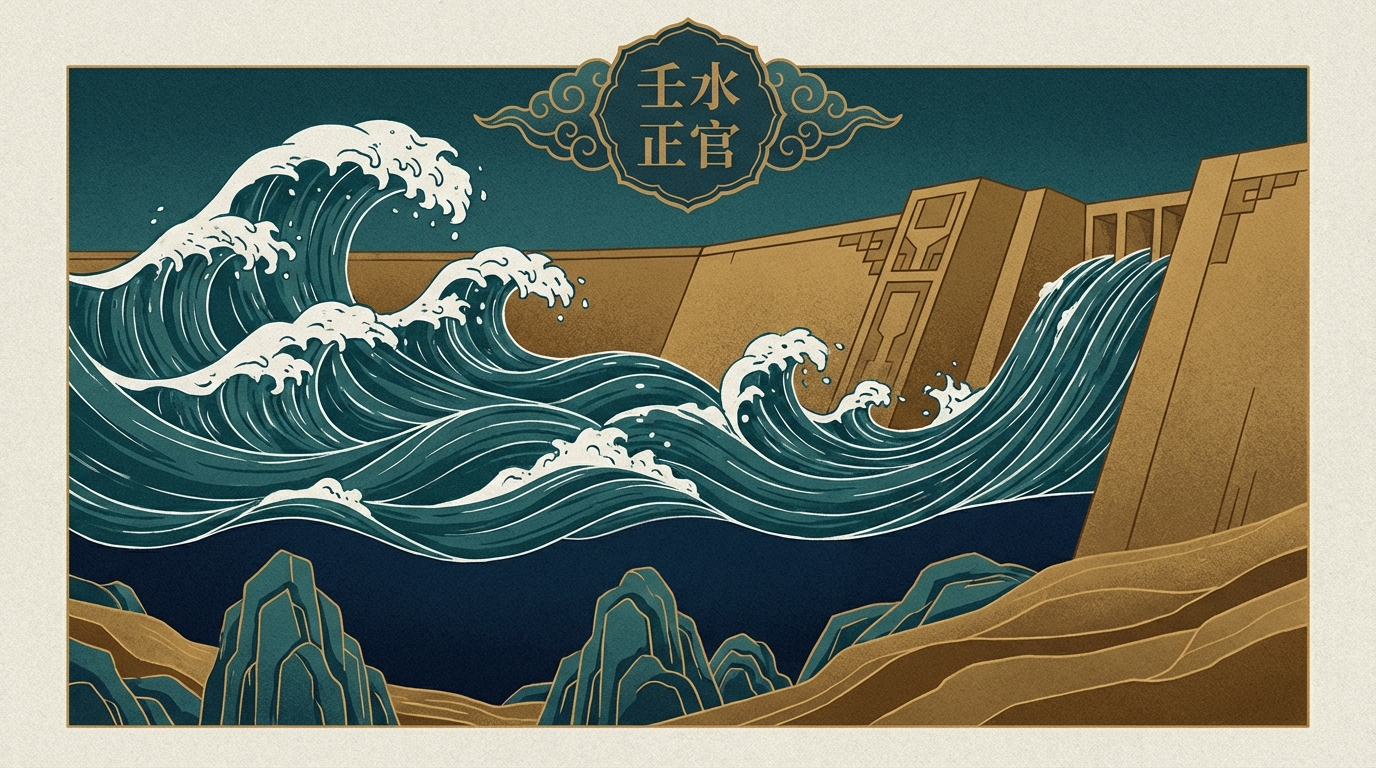
The river doesn't choose its course.
The river follows the path that gravity and terrain define — the lowest available route, the gradient that pulls the accumulated hydraulic volume toward the sea. Left without banks, the river spreads across the landscape in whatever direction gravity permits: the flood plain's broad, shallow, undirected sheet of water that saturates everything equally and reaches the sea slowly, inefficiently, after dispersing its hydraulic force across the maximum possible surface area.
The banks give the river its direction.
Not the geological canyon walls of ancient stone — the canyon is the mountain's work, the geological formation of the hard rock that takes millions of years to carve and holds the river in the deepest and most permanent channels. What shapes most rivers most of the time is something more modest, more cultivated, more actively maintained: the riverbank made of managed earth. The cultivated soil that has been worked and shaped and maintained by the patient management of erosion, by the planting of roots that hold the bank's soil together, by the human and natural processes of cultivation that keep the bank's profile intact. The garden-quality soil that knows how to hold its form in the presence of the river's hydraulic force.
The managed riverbank does not fight the river. The managed riverbank defines the channel through which the river's hydraulic inevitability finds its most productive direction.
This is Zheng Guan (正官, Direct Officer) for Ren Water — the riverbank that shapes the river's course.
For Ren Water (壬水, Yang Water), Zheng Guan is Ji Earth (己土, Yin Earth) — the cultivated garden soil, the managed earth whose patient cultivation defines the channel walls through which the river's hydraulic force finds its productive direction. Earth controls Water; opposite polarity (Yin Earth controlling Yang Water) gives Zheng Guan its distinctive quality of cooperative governance — the most naturally compatible authority relationship, the opposite-polarity control that the river yields to rather than resists. In BaZi (八字), Zheng Guan (正官) represents the opposite-polarity controlling element — the Direct Officer, associated with: the legitimate, cooperative, productive authority relationship — the managed riverbank that the river flows within rather than against; the opposite-polarity governance that the Day Master accepts — the river finding its most productive direction within the channel the cultivated earthwork defines; the structure and discipline that makes the Day Master's force most productively directed — the bank that concentrates the river's hydraulic force into the maximum directional momentum; the reliable, responsible authority relationship — the managed earthwork that maintains its form consistently through patient cultivation; and the Direct Officer's signature quality — the governance that enhances the Day Master's productive force by giving it the channel direction that undirected hydraulic inevitability cannot find alone.
Part of the Day Master × Ten God series. See also: Ren Water Day Master and Zheng Guan overview.
What Zheng Guan Means for Ren Water
In BaZi, Zheng Guan (正官) is the opposite-polarity controlling element — the Direct Officer representing the legitimate, cooperative, productive authority relationship where the Day Master's force finds its most productive direction within the channel the governance defines. For Ren Water (Yang Water), Zheng Guan is Ji Earth (己土, Yin Earth) — the cultivated garden soil whose managed earthwork defines the channel walls through which the river flows most powerfully and most productively toward its destination.
Zheng Guan classically represents: the legitimate, cooperative, accepted authority relationship — the riverbank the river flows within rather than against; the opposite-polarity governance that enhances rather than obstructs — the channel that concentrates the hydraulic force rather than dispersing it; the structure, discipline, and direction that makes the Day Master's force most effective — the bank that gives the river its course; responsibility and reliability — the managed earthwork that maintains its form consistently through patient cultivation; and the Direct Officer's signature quality — the governance that the Day Master accepts because it makes the Day Master's own force more effective, not less.
The Ren Water Zheng Guan dynamic is specifically about channeling force: the river without banks disperses into the flood plain; the river with well-managed banks concentrates its hydraulic force into the maximum directional momentum. The governance doesn't reduce the river's force — it focuses it. The managed earthwork doesn't slow the river — it directs it. The Zheng Guan's authority is the authority that makes the Day Master's hydraulic inevitability most fully effective by giving it the channel direction that the undirected force cannot find alone.
How This Shows Up in Your Personality
The channel-finding quality
Ren Water Zheng Guan people often have an unusual quality of channel-finding — the river's instinct for the managed earthwork that defines the most productive direction for the hydraulic force. This shows as: a natural receptiveness to the legitimate authority that defines productive channels — the managed riverbank that the river flows within without resistance; an unusual comfort with governance that enhances rather than obstructs — the channel that concentrates the hydraulic force rather than dispersing it; and the Ren Water Zheng Guan channel-finding quality — the instinct for finding and accepting the cultivated earthwork whose channel definition makes the Day Master's hydraulic inevitability most productively directed.
This channel-finding quality often shows as: a quality of productive responsiveness to legitimate structure — the river that flows more powerfully within the bank's channel than it does across the undirected flood plain; an unusual appreciation for the governance that focuses force rather than dispersing it; and the specific clarity that comes from the channeled direction — the river's understanding that the bank's cultivated earthwork is not a limitation of its force but the definition of the direction in which that force is most effective.
The cultivation-receptivity quality
Ji Earth's governance is cultivated rather than geological — the managed soil that has been tended and shaped and maintained rather than the canyon wall of ancient stone. Ren Water Zheng Guan people often have this cultivation-receptivity quality: the natural recognition that the most productive authority is not the geological force that carves the permanent canyon but the cultivated earthwork that tends and maintains the channel's profile through patient management. This shows as: a natural comfort with governance that is earned through cultivation rather than imposed through geological force; a quality of appropriate authority recognition — the river that yields to the managed earthwork's bank because the cultivated earth has done the work of defining and maintaining the channel; and the Ren Water Zheng Guan cultivation-receptivity quality — the responsiveness to the patient, cultivated, actively maintained authority whose channel definition is the result of management rather than geological imposition.
The focused-force quality
The river within well-managed banks flows faster and more powerfully than the river dispersed across the flood plain. The channel concentrates the hydraulic force; the banks give the concentrated force its direction. Ren Water Zheng Guan people often have this focused-force quality in their relationship with authority: the natural understanding that the most powerful expression of the hydraulic force is not the undirected flood plain dispersal but the channeled concentration within the managed earthwork's bank. This shows as: a quality of force-focusing responsiveness — the river that becomes more powerful within the channel than it was across the flood plain; an unusual orientation toward the governance that concentrates and directs rather than disperses; and the Ren Water Zheng Guan force-focusing quality — the recognition that the managed bank's cultivated authority makes the Day Master's hydraulic force more effective rather than less, and the natural acceptance of the governance relationship that produces this focused concentration.
The course-definition quality
The cultivated riverbank doesn't just hold the water — it defines the course. The direction the river travels, the path it takes toward the sea, the meanders and the straight runs and the bends — all of this is shaped by the bank's earthwork. The river's hydraulic inevitability guarantees it will reach the sea; the bank's cultivated earthwork shapes how it reaches the sea, which territories it travels through, which landscape it serves with its hydraulic presence on the way. Ren Water Zheng Guan people often have this course-definition quality: the recognition that the governance's most productive contribution is not the force of the river itself but the definition of the course through which the river's force most completely serves its productive purpose. This shows as: a natural orientation toward the authority that clarifies direction rather than just imposing constraint; a quality of course-clarity in relationship to governance — the river that knows its direction more clearly within the bank's channel than it does across the undirected flood plain; and the Ren Water Zheng Guan course-definition quality — the governance relationship that is most productive when it defines the most complete and most effectively directed course for the hydraulic inevitability that was already going to reach the sea.
Career Implications
Where Ren Water Zheng Guan thrives
Structured institutional environments with clear hierarchies. The channel-finding quality and the focused-force quality are most professionally valuable in institutional environments where clear hierarchical channels — the cultivated earthwork that defines the river's productive direction — concentrate the Day Master's hydraulic force into its most effectively directed professional expression. Ren Water Zheng Guan people in well-structured institutional environments often find that the legitimate authority structure's channel definition makes their natural hydraulic force dramatically more effective and more productively directed than it is in the undirected flood plain of unstructured professional environments.
Public service, regulatory, and governance roles. The course-definition quality and the cultivation-receptivity quality are most professionally valuable in public service and governance contexts where the cultivated earthwork of institutional authority — the managed soil whose patient maintenance defines the channel for collective hydraulic force — is the primary professional context. Ren Water Zheng Guan people in public service and governance roles often find that their natural channel-finding receptiveness to legitimate authority makes them the most effectively contributing members of the institutional structures that define collective direction.
Established organizations with cultivated authority structures. The cultivation-receptivity quality is most professionally valuable in established organizations where the authority has been earned through patient cultivation — where the managed earthwork of the institutional channel has been maintained through the consistent work of responsible governance. Ren Water Zheng Guan people in established organizations with cultivated authority structures often find that their natural responsiveness to the earned authority produces the most effectively directed and most powerfully channeled professional contributions.
For more on BaZi and career choices, see our career guide.
Where friction arises
Undirected, unstructured, or chaotic environments. The most significant professional friction for Ren Water Zheng Guan is the environment without managed banks — the unstructured, undirected professional context where the river's hydraulic force disperses across the flood plain without the channel definition that focuses it. Ren Water Zheng Guan people in unstructured environments sometimes find that without the cultivated earthwork's channel definition, the hydraulic force is less effectively directed than it could be.
When the bank erodes. The managed earthwork requires maintenance — the cultivated soil that defines the channel must be actively tended to prevent erosion. When the Zheng Guan's authority erodes, the channel it defines begins to collapse, and the river spreads back toward the flood plain. The most significant governance risk for Ren Water Zheng Guan is the authority structure that loses its cultivated maintenance — the bank that wasn't tended and begins to erode.
Relationship Dynamics
The channel-and-river quality in close relationships
In close relationships, Ren Water Zheng Guan brings the channel-and-river dynamic: the encounter with Ji Earth-quality authority figures, partners, and governance structures whose cultivated Yin Earth patience defines the channel through which the river's hydraulic force finds its most productive direction. Ji Earth presences in Ren Water's life often provide: the cultivated channel definition that focuses the river's force into productive direction without fighting or obstructing it; the course clarity that comes from the managed earthwork's patient cultivation — the direction the river travels when it has found the channel that was most carefully and most productively defined; and the legitimate authority relationship — the governance the river accepts because it makes the river's own hydraulic force more effective.
The channel-definition quality in relationships
The most productive Ren Water Zheng Guan relationship dynamic is the channel-and-river complementarity: Ji Earth's cultivated earthwork defining the course, the river's hydraulic force finding its most productive direction within the channel. The most challenging dynamic is the eroding bank: the authority structure that has not been maintained through patient cultivation, whose channel definition has begun to collapse, allowing the river to spread back toward the undirected flood plain. The key to the most productive Zheng Guan relationship is the maintained bank: the authority whose cultivated earthwork is consistently tended, whose channel definition is reliably intact, whose governance the river can accept because the bank has proven its ability to maintain the course.
Luck Cycle Interactions
When Ji Earth (or other Yin Earth or Chou/Wei influences) enter your 10-year luck pillars (大运) or annual pillars (流年):
The authority channel is most clearly defined. Ji Earth luck periods bring the Ren Water's Zheng Guan governance relationship into its most direct operational presence — the cultivated earthwork is most actively maintained, the channel definition is most precisely intact, the legitimate authority relationship is most cooperatively productive. These periods often bring: the most clearly defined professional and personal channels — the cultivated banks whose managed earthwork focuses the hydraulic force into maximum directional momentum; opportunities for the most effectively directed and most powerfully channeled expressions of the Day Master's hydraulic force; and the course clarity that comes from the most reliably maintained cultivated authority structure.
The governance is most naturally cooperative. Ji Earth luck periods are the times when the Zheng Guan authority relationship is most naturally receptive — when the cultivated earthwork's channel definition is most effectively channeling the river's force into productive direction. Ren Water Zheng Guan people who invest in the most cultivated and most consistently maintained authority relationships during Ji Earth luck periods often find that the channel definition produced during these periods generates the most durably productive and most effectively directed professional outcomes.
Watch for erosion dynamics. The most significant risk of Ji Earth luck periods is the cultivated earthwork's maintenance being neglected — the bank whose patient management has been interrupted, whose channel definition has begun to erode, allowing the river's force to spread back toward the undirected flood plain. The management practice for Ji Earth luck periods is bank maintenance: investing consistently in the cultivated authority relationships whose channel definition most productively focuses the hydraulic force.
For a full view of how luck cycles affect Ren Water, see the Ren Water Day Master guide.
Practical Advice
Find the cultivated bank, not the geological canyon. The most important Zheng Guan orientation for Ren Water is recognizing the difference between the geological canyon walls of forced constraint and the cultivated earthwork of managed governance — and seeking the cultivated earthwork. The geological canyon confines; the managed riverbank channels. Ren Water Zheng Guan people who seek the cultivated, earned, patiently maintained authority structure rather than the geological force of imposition find the governance relationships that most productively focus their hydraulic force.
Accept the channel as the enhancement of force. The managed riverbank doesn't reduce the river's hydraulic force — it focuses it into maximum directional momentum. Ren Water Zheng Guan people who accept the Zheng Guan's governance as the enhancement of their force rather than the limitation of it produce the most effectively directed and most powerfully channeled professional and personal outcomes.
Invest in the bank's maintenance. The cultivated earthwork requires consistent maintenance — the managed soil that defines the channel must be actively tended to prevent erosion. Ren Water Zheng Guan people who invest in the consistent maintenance of the authority relationships that define their most productive channels — who tend the cultivated earthwork rather than expecting it to maintain itself — produce the most durably channeled and most consistently directed outcomes.
Let the bank define the course. The river's hydraulic inevitability guarantees it will reach the sea; the bank's cultivated earthwork shapes how it reaches the sea and which landscape it serves on the way. Ren Water Zheng Guan people who allow the governance's cultivated authority to define the course — who trust the managed earthwork's channel definition rather than insisting on finding their own undirected path across the flood plain — produce the most completely directed and most productively useful hydraulic expression.
FAQ
What is Zheng Guan for Ren Water in BaZi?
Zheng Guan (正官), the Direct Officer, for Ren Water Day Masters is Ji Earth (己土, Yin Earth) — the cultivated garden soil, the managed earth whose patient cultivation defines the channel walls through which the river's hydraulic force finds its most productive direction. Earth controls Water; opposite polarity (Yin Earth controlling Yang Water) gives Zheng Guan its distinctive quality of cooperative governance — the most naturally compatible authority relationship, where the controlled element accepts the governance because it makes the Day Master's own force more effective. In BaZi, Zheng Guan represents the opposite-polarity controlling element — the Ten God most associated with legitimate authority, productive structure, and the governance that channels and focuses the Day Master's force rather than obstructing it. For Ren Water, Zheng Guan is the riverbank that shapes the river's course: the cultivated earthwork whose managed profile defines the channel direction through which the river's hydraulic inevitability finds its most completely productive and most effectively directed expression. Get your free reading to see where Zheng Guan appears in your chart.
How does Ren Water Zheng Guan differ from Ren Water Pian Guan?
Zheng Guan for Ren Water is Ji Earth (Yin Earth, cultivated garden soil) — opposite polarity, the most naturally compatible authority relationship, the cultivated earthwork that the river accepts because it channels the hydraulic force into productive direction. Pian Guan for Ren Water is Wu Earth (Yang Earth, the mountain) — same polarity, the more challenging authority, the geological formation whose scale matches the river's own Yang force and creates a more dynamic tension between the river's hydraulic inevitability and the mountain's geological mass. The cultivated bank shapes the course cooperatively; the mountain defines the valley with geological force. The Direct Officer is the managed, earned, cultivated authority; the 7 Killings is the geological, structural, equal-scale authority.
Want to understand how Zheng Guan operates in your specific Ren Water chart — which cultivated authority structures most productively channel your hydraulic force, how to find the managed earthwork whose course definition most completely focuses your hydraulic inevitability, and how to maintain the bank whose patient cultivation most durably defines your most productive professional and personal direction? Get your free BaZi reading and discover your complete Direct Officer profile and channel development path.