
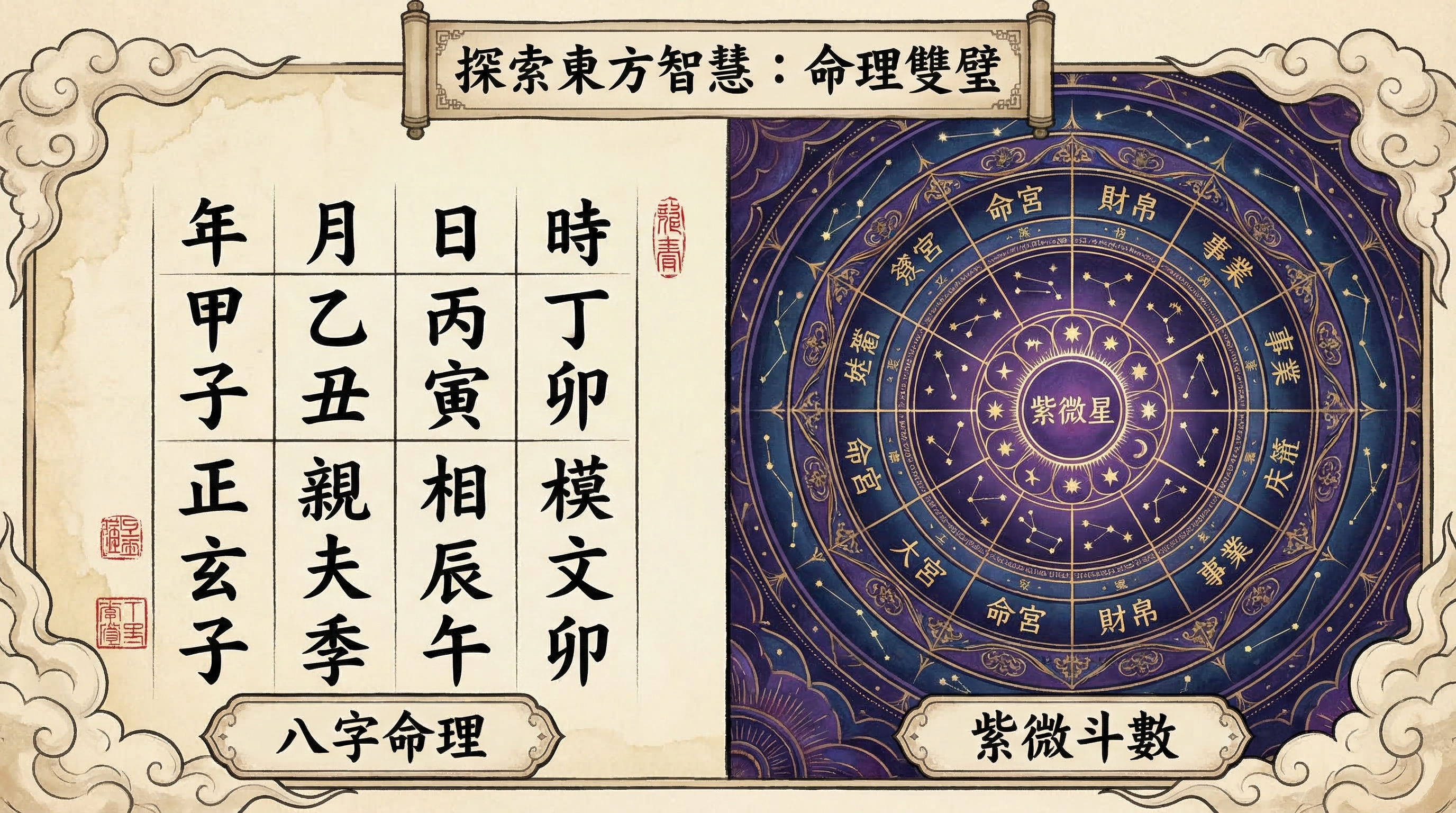
China didn't produce just one system for reading life patterns in a chart. It produced two. And they're nothing alike.
BaZi (八字, bā zì) and Zi Wei Dou Shu (紫微斗數, zǐ wēi dǒu shù) are the two heavyweights of Chinese metaphysics. Both use your birth data. Both claim to map your life. But they approach the problem from completely different angles, and the readings they produce feel nothing like each other.
BaZi (Four Pillars) is a Chinese metaphysical system based on Five Elements and the Heavenly Stems/Earthly Branches of your birth time. Zi Wei Dou Shu (Purple Star Astrology) maps over 100 stars across 12 life palaces using your birth data. BaZi excels at elemental balance analysis, timing through Luck Cycles, and practical compatibility readings. ZWDS excels at event-level detail, personality nuance, and mapping specific life domains through its palace system.
If you've been curious about Chinese astrology beyond the usual zodiac animal stuff, these are the two systems worth knowing. This guide breaks down how they differ, what each one does well, and how to decide which one fits your needs.
Curious what your BaZi chart looks like? Try a free reading here and see your Four Pillars in seconds.
A quick history lesson
Both systems are old. But BaZi is older.
BaZi traces back to the Tang Dynasty (around 618-907 CE), though its roots go even further. The core framework, the interaction of Five Elements (五行, wǔ xíng) through Heavenly Stems and Earthly Branches, was already in use during the Han Dynasty for calendrical calculations. A scholar named Li Xuzhong (李虛中) is generally credited with formalizing BaZi as a chart-reading framework. Later, during the Song Dynasty, Xu Ziping (徐子平) refined it into the Day Master-centered approach that practitioners still use today.
Zi Wei Dou Shu appeared later, during the Song Dynasty (960-1279 CE). Tradition credits a Taoist sage named Chen Tuan (陳摶) with its creation, though this is debated among historians. What's not debated is that ZWDS was clearly influenced by both Chinese astronomy and the imperial star-mapping traditions. The name itself tells you everything: Zi Wei (紫微) refers to the Purple Star, also called the Emperor Star, which is the pole star around which all other stars revolve.
The historical difference matters because it shaped how each system thinks. BaZi grew out of earthly, elemental philosophy. ZWDS grew out of celestial observation. One looks at the energy of time. The other maps the stars of fate.
How each system actually works
This is where the two systems diverge most sharply.
BaZi: eight characters, infinite combinations
BaZi converts your birth year, month, day, and hour into four "pillars," each containing a Heavenly Stem and an Earthly Branch. That gives you eight characters total, hence the name (八字 literally means "eight characters").
The core of your chart is your Day Master (日主, rì zhǔ), the Heavenly Stem of your Day Pillar. It represents your core identity. Everything else in the chart is read in relation to this center point: what supports you, what challenges you, what brings opportunity, what creates tension.
BaZi analysis works through elemental relationships. Your chart contains a mix of Wood, Fire, Earth, Metal, and Water. The way these elements interact with each other, and with the elements flowing through each year, month, and decade, tells the story of your life. The system recognizes patterns called the Ten Gods (十神), which describe how each element relates to your Day Master: some represent wealth, some represent authority, some represent creativity, and so on.
The math is relatively straightforward once you learn it, which is one reason BaZi has always had wider adoption among everyday people. A farmer in rural China 500 years ago could learn the basics from a village elder. You didn't need access to imperial libraries or specialized star charts. This grassroots accessibility shaped BaZi's DNA, and it's still one of its greatest advantages today.
Zi Wei Dou Shu: a palace of stars
ZWDS works very differently. It plots your birth data onto a chart of twelve "palaces" (宮, gōng), each governing a different life domain: self, siblings, spouse, children, wealth, health, career, friends, travel, property, fortune, and parents.
Then it populates these palaces with stars, over 100 of them in the full system, though about 14 major stars (主星) carry most of the weight. The Purple Star (紫微星) is the most important, and where it lands in your chart determines the placement of every other star.
Each star has its own personality. Zi Wei is the emperor: dignified, commanding, sometimes arrogant. Tian Ji (天機) is the strategist: clever, restless, always thinking three moves ahead. Tai Yang (太陽) is the sun: generous, outgoing, but prone to burnout. The combination of which stars land in which palaces, modified by additional stars and transformations (四化, sì huà), creates the reading.
If BaZi feels like reading an equation, ZWDS feels like interpreting a map. The palace system gives you a visual, spatial sense of where energy concentrates in your life.
What each system does best
Neither system is "better." That's a lazy answer, but it happens to be true. They have genuinely different strengths.
Where BaZi excels
Timing. BaZi's Luck Cycle system (大運, dà yùn) is extraordinarily precise for understanding the rhythm of your life. Each decade brings a different elemental energy, and when you layer annual and monthly influences on top of that, you get remarkably specific timing guidance. "Your 40s will be your strongest decade for career" or "2027 brings a wealth element you haven't seen in years" are the kinds of statements BaZi makes well.
Elemental balance. Because BaZi reduces everything to five elements, it gives you clear, practical guidance about what's missing in your life and how to supplement it. Too much Fire? Add Water activities. Weak in Wood? Pursue creative or educational endeavors. This simplicity makes BaZi useful in ways that more complex systems struggle to match.
Compatibility. BaZi compatibility analysis compares elemental dynamics between two people across all four pillars. It can pinpoint not just whether you're compatible, but where the friction will show up: finances, communication, values, or intimacy. For a closer look at how this works, see our love compatibility guide.
Accessibility. You can learn the basics of BaZi in a weekend. Not mastery, obviously, but enough to read your own chart at a useful level. The Five Elements framework is intuitive, the Day Master concept is straightforward, and the logic is transparent. You don't need to memorize 100+ stars.
Where Zi Wei Dou Shu excels
Life domain detail. The twelve-palace system gives ZWDS a natural advantage when you want to zoom into one area of life. Want to know about your career? Look at the Career Palace. Worried about health? Check the Health Palace. BaZi can answer these questions too, but ZWDS structures them more explicitly.
Character depth. ZWDS star personalities create vivid, detailed character portraits. Where BaZi might tell you "you're a Yin Fire Day Master, gentle and insightful," ZWDS might say "you have Tian Tong in your Self Palace with Hua Lu, making you comfort-seeking, quietly ambitious, and blessed with good fortune in leisure." The star system allows for more granular personality descriptions.
Relationship mapping. Because ZWDS has dedicated palaces for spouse, children, siblings, friends, and parents, it naturally maps your relationships in a structured way. Each relationship gets its own "room" in the chart, populated with specific stars that describe the nature of that connection.
Event prediction. Some ZWDS practitioners claim stronger accuracy for predicting specific events (marriage year, career change, health crisis) because the star-palace interactions create more precise trigger points. This is debatable and depends heavily on the practitioner's skill, but it's a common argument in favor of ZWDS.
The practical differences, at a glance
| Aspect | BaZi (Four Pillars) | Zi Wei Dou Shu (Purple Star) |
|---|---|---|
| Foundation | Five Elements + Yin/Yang | 100+ stars in 12 palaces |
| Core identity | Day Master (1 of 10) | Major star in Self Palace (1 of 14) |
| Chart structure | 4 pillars, 8 characters | 12 palaces with star placements |
| Timing system | 10-year Luck Cycles + annual pillars | Decade, annual, and monthly palace shifts |
| Strength | Elemental balance, timing, compatibility | Life domain detail, character depth |
| Learning curve | Moderate (weeks to basics) | Steep (months to basics) |
| Birth data needed | Year, month, day, hour | Year, month, day, hour |
| Popularity | Wider global adoption | More popular in Taiwan, Southeast Asia |
When to use which
Here's my honest take, knowing both systems.
Start with BaZi if you're new to Chinese astrology. The Five Elements framework gives you an intuitive foundation. You'll understand your own chart faster, and the concepts translate directly into daily life. "I need more Water energy" is something you can act on right away, in a way that "Tian Ji is in my Travel Palace" isn't, unless you already know what Tian Ji means.
Use BaZi for timing decisions. When to change jobs. When to launch a business. When to expect relationship shifts. BaZi's Luck Cycle system was built for this, and it's where the system is most practically useful.
Turn to ZWDS when you want depth on a specific life area. If you already know your BaZi and want a second opinion on, say, your career trajectory or family dynamics, ZWDS can provide a different angle with its palace system.
Use ZWDS for character analysis. If you're fascinated by personality typing and want maximum detail, the star system in ZWDS gives you more variables to work with. It's the system that tends to produce "how did you know that?" moments during readings, because the star personalities are so specific.
Want to see what BaZi reveals about your career path? Get your free reading and check your elemental strengths.
Can you combine them?
Yes, and serious practitioners often do.
In Chinese metaphysics, using multiple systems together is called "cross-referencing" (參考, cān kǎo). The idea is simple: if BaZi and ZWDS both point to the same conclusion, you can have higher confidence in that reading. If they disagree, that tension itself becomes useful information.
For example, your BaZi might show that your 30s are dominated by Wealth element energy, suggesting a financially productive decade. Your ZWDS chart might confirm this by placing prosperity stars in your Wealth Palace during the same period. Or it might complicate things by also showing challenging stars in your Health Palace, hinting that the financial gains come at a physical cost, so pace yourself.
The systems aren't competitors. They're complementary lenses. But learning both takes serious time, and for most people, going deep in one system produces better results than being shallow in both.
What this looks like in practice
Theory is fine, but how do these systems actually read a person differently? Let's walk through a hypothetical example.
Imagine someone born on a spring afternoon, a woman in her early 30s wondering about her career direction.
A BaZi reading might say: "You're a Yin Wood Day Master (乙木), born in the month of Wood's peak strength. Your chart has strong Wood and Water, but almost no Fire or Earth. This means you're creative, adaptable, and intellectually sharp, but you tend to overthink and struggle to finish what you start. Your Wealth element is Earth, and since it's weak in your chart, money comes through sustained effort rather than windfalls. Good news: your current Luck Cycle (ages 28-38) brings strong Earth energy, so this decade is actually your best window for building financial foundations. Take the career risk now, not later."
A ZWDS reading of the same person might say: "Tian Ji and Tai Yin sit together in your Career Palace, suggesting intelligence and a talent for planning, research, or strategy. But Tian Ji is restless. You'll change direction at least once before 35, probably in a field involving analysis or communication. Your Wealth Palace has Tian Fu with Hua Lu, pointing to stable finances once you settle into the right role. The issue is your Self Palace: Tan Lang brings charm and ambition but also distraction. Focus will be your biggest challenge."
Both readings paint a picture of someone bright but scattered, with financial potential that requires focus to realize. But they arrive at that conclusion through different vocabularies and different structural logics. The BaZi reading gives you elemental prescriptions (add Earth). The ZWDS reading gives you star-character insights (watch out for Tan Lang's distraction tendency).
Neither is wrong. They're just different maps of the same territory.
Common misconceptions
A few things people get wrong when comparing these systems.
"ZWDS is more accurate than BaZi." You'll hear this from ZWDS enthusiasts, but accuracy depends far more on the practitioner than the system. A skilled BaZi reader will outperform a mediocre ZWDS reader every time. The tool matters less than the person using it.
"BaZi is simpler, so it must be less powerful." Fewer variables doesn't mean less depth. Chess has only six types of pieces. BaZi's five elements generate extraordinary complexity through their interactions. Simplicity in framework is not the same as simplicity in output.
"You need ZWDS for serious chart reading." BaZi has been a primary chart-analysis tool for Chinese emperors, military strategists, and business leaders for centuries. It's been tested across thousands of years and billions of readings. It doesn't need ZWDS to be complete, though ZWDS can add perspective.
"They'll give you the same reading." They won't. The systems are different enough that they highlight different aspects of your life. That's the whole point of having two systems. If they said the same thing, one would be redundant.
The modern context
Both systems are experiencing a renaissance outside of Asia, but BaZi has a clear lead in global adoption. Part of this is accessibility: the Five Elements concept translates across cultures easily. Saying "I'm a Water person" communicates something immediate, even to someone who's never heard of BaZi. ZWDS star names, by contrast, require cultural context to make sense.
The internet has also leveled the playing field. Twenty years ago, getting a ZWDS reading required finding a specialist, usually in Taiwan or Hong Kong. Today, both systems have online calculators and communities, though BaZi resources in English are still more abundant.
For someone exploring Chinese astrology for the first time, BaZi remains the better entry point. Its concepts are more portable, its tools more widely available, and its practical applications more immediately useful. You can get a meaningful BaZi reading in minutes. A ZWDS reading takes longer to generate and longer to interpret.
That said, if you're the kind of person who loves going deep, ZWDS rewards that investment handsomely. Its palace-and-star system has a richness that keeps scholars studying for decades.
Where to start
You're reading this, so you've already started.
If BaZi interests you, the fastest way to learn is to look at your own chart. Abstract theory becomes concrete when you can see your own Day Master, your elemental balance, and your Luck Cycles mapped out in front of you.
We built Eastern Fate to make that step as easy as possible. Enter your birth details, and you'll see your complete Four Pillars chart, your Day Master identity, Five Elements distribution, and personalized insights, When a birthplace is entered, true solar time adjusts the birth hour by birthplace longitude.
Enter your birth details on Eastern Fate and discover your BaZi chart for free. See your Four Pillars, Day Master, elemental balance, and what the current year means for you, all in under a minute.
Discover your BaZi chart at Eastern Fate
Frequently Asked Questions
What is the difference between BaZi and Zi Wei Dou Shu?
BaZi (Four Pillars) reads elemental patterns through eight characters at your birth time, using Heavenly Stems and Earthly Branches. It focuses on elemental balance, Day Master identity, and 10-year Luck Cycles. Zi Wei Dou Shu (Purple Star Astrology) maps over 100 stars across 12 life palaces, providing granular detail about specific life areas like career, marriage, wealth, and health. BaZi is simpler to learn and better for timing and compatibility. ZWDS offers more narrative detail and event-level specificity.
Which is more accurate, BaZi or Zi Wei Dou Shu?
Neither is inherently more accurate — they measure different things. BaZi excels at identifying elemental strengths and weaknesses, timing decisions through Luck Cycles, and compatibility analysis between two people. ZWDS excels at detailed personality portraits, mapping specific life events across 12 domains, and describing the quality of experiences (not just timing). Many serious practitioners study both systems and use them complementarily.
Can you use BaZi and Zi Wei Dou Shu together?
Yes, and many experienced Chinese metaphysics practitioners do exactly this. A common approach: use BaZi for the big-picture elemental framework (strengths, timing, compatibility) and ZWDS for detailed life-domain analysis (career specifics, relationship narratives, health patterns). When both systems point to the same conclusion, practitioners treat that as a strong signal. When they diverge, it reveals nuance worth exploring.
Is Zi Wei Dou Shu the same as Chinese astrology?
Zi Wei Dou Shu is one form of Chinese astrology, but it's not the only one. BaZi (Four Pillars) is equally important and more widely practiced in many regions. The Chinese zodiac animals that most Westerners know are a simplified version of the Earthly Branch system used in BaZi, not ZWDS. Both BaZi and ZWDS use your exact birth date and time, but they employ completely different analytical frameworks.