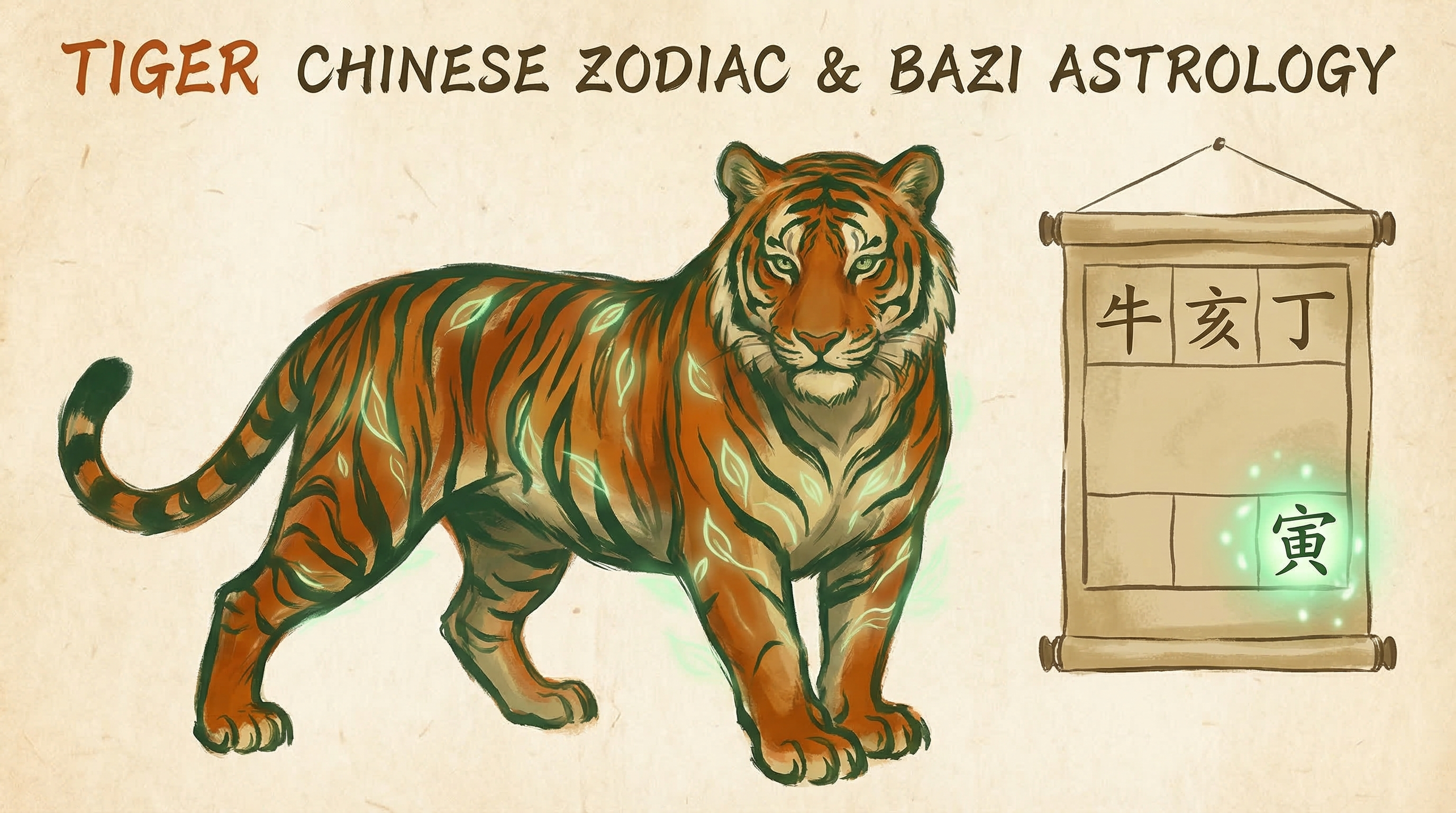
This article is part of our Chinese Zodiac series. New to BaZi? Start with our beginner's guide.
You notice her before she says a word. She walks into the conference room five minutes late, drops her bag on the table, and somehow the energy shifts toward her. The presentation isn't polished (she skipped two slides, improvised the closing) but nobody cares. The room is convinced. Afterwards, three people ask for her business card. Two others quietly decide they don't like her.
That's the Tiger.
Magnetic. Polarizing. Impossible to ignore. In BaZi, the Tiger isn't just a zodiac animal. It's an Earthly Branch carrying one of the most volatile energy profiles in the entire system. I've watched it play out in readings for years, this weird pattern where people either love a Tiger instantly or feel sort of threatened by them. No in-between. If someone's chart has strong Tiger energy, they're probably living big, moving fast, and not losing sleep over whether everyone's comfortable with that.
So what does Tiger actually mean once you move past the fortune cookie version?
The Earthly Branch Yin (寅)
Every Chinese zodiac animal corresponds to an Earthly Branch (地支, dì zhī). The Tiger's is Yin (寅, yín), the third of twelve. Look, understanding Yin as a branch matters way more than memorizing generic personality traits. The branch tells you what energies are actually running under the hood.
Element and polarity
Yin belongs to the Wood element with Yang polarity. Dominant energy: Yang Wood (甲木, jiǎ mù). Tall trees, upward growth, structural ambition. Yang Wood doesn't bend. It reaches straight for the sky, and if something's in the way, it pushes through or just breaks.
Tiger people seem direct because of this. Their primary energy isn't subtle at all. Think oak trunk, not vine.
Hidden stems
Every Earthly Branch in BaZi has hidden Heavenly Stems (藏干, cáng gān) tucked inside, adding complexity. Yin has three of them:
- Jia Wood (甲) is the dominant stem, the main event. Leadership, growth, ambition, structure.
- Bing Fire (丙) sits underneath, giving Tigers their warmth. Bing Fire is the sun. Bright, generous, hard to miss.
- Wu Earth (戊) is frankly the runt of the litter. Adds some practicality, some grounding. But it's often too weak to do the job properly.
Here's what makes that combination interesting. Jia Wood gives drive. Bing Fire makes Tigers the kind of person you can't stop looking at. And Wu Earth? It's supposed to keep them grounded. In theory. When you meet a Tiger who's all vision and charisma but can't finish anything? Weak Wu Earth. Nine times out of ten.
Seasonal position
Yin sits at early spring on the Chinese calendar. Roughly February. Winter's breaking, new growth pushing up. It's the very start of Wood season, all raw upward energy.
Tigers are starters. That's it, really. They open doors, charge into new territory, kick off projects with terrifying enthusiasm. Ask them to maintain what already exists and watch their eyes glaze over.
The branch carries an energetic signature of beginning. First push of a seedling through frozen soil. In the daily cycle, Yin maps to 3:00-5:00 AM, the hour just before dawn. Kind of fitting, honestly. Tigers tend to feel most alive right at the edge of change, that moment when things are about to shift but haven't yet.
Personality traits of the Tiger
These hit hardest when Yin (寅) shows up in your Day Branch (the one representing your core self), but Tiger energy colors your chart wherever it appears. Not sure what branches you've got? Check with a free BaZi reading.
Courage and boldness
Tigers don't deliberate. They see a problem, they move. Not recklessness exactly (they've usually read the room faster than everyone else) but from the outside? Looks reckless.
I knew one who quit a logistics job in Shenzhen to launch a tea brand. No business plan. Just quit. It worked, by the way. That's Tigers for you. Volunteering for assignments nobody else wants, walking into negotiations without notes, somehow winning anyway. Drives the rest of us a little crazy.
Jia Wood's upward energy is what's behind this. Trees don't grow sideways to dodge obstacles. In a crisis, others are still processing what happened while the Tiger's already three steps deep into a response.
Leadership instinct
Natural leaders, yes. Comfortable ones? Not always.
They lead because they can't help it. Not because they want a title. In groups, they just... take over. Reorganize the plan, redirect the conversation, or start doing whatever everyone else is still debating. Depending on who's watching, this is either galvanizing or incredibly annoying.
Tiger leadership is direct. Blunt, if we're being real about it. No consensus-building. They pick a direction and assume people will follow. Sometimes teams accomplish things they didn't think possible. Other times people feel like they got run over by a truck.
Restlessness and impatience
The shadow side. Directly tied to spring energy, which is explosive and forward-moving and absolutely does not want to sit still.
Tigers get bored fast. Routine kills them. They're the ones who rearrange their apartment every few months, cycle through hobbies like they're sampling a buffet (pottery in January, rock climbing by March, probably something with fermentation by June), and start fidgeting visibly once a meeting goes past 45 minutes.
And the impatience extends to people around them. They expect everyone to keep up. When someone needs more time to think or process, Tigers genuinely don't understand why. It's not malicious. They just... can't relate. This causes real problems in relationships and at work if they don't learn to check it.
Generosity (yes, really)
This surprises people who only see the intensity, but that Bing Fire hiding inside Yin gives Tigers genuine warmth. They're generous with money, time, attention, whatever they've got. Think: the friend who grabs the check before you even see the bill. The manager who quietly goes to bat for your promotion.
Not strategic generosity either. Bing Fire has a solar quality, it just shines on everyone. Tigers give because it feels right. They're not tracking favors. Problem is they overextend, then feel resentful when nobody returns the energy. Seen that pattern a hundred times.
Rebelliousness
Tigers question authority. Sometimes loudly. More often it's a quiet refusal, just not following rules they think are pointless. Jia Wood is rigid and vertical. A tall tree doesn't bow.
In practice this means clashing with rigid hierarchies, ignoring policies that seem arbitrary, having zero tolerance for tradition-for-tradition's-sake. Competence earns their respect. Titles don't. A Tiger employee will walk through walls for a leader they trust. That exact same Tiger will undermine an incompetent boss without thinking twice about it. I watched this play out at consulting firms in Hong Kong more times than I should probably admit.
Charisma
Probably the most recognizable Tiger trait, and the hardest to explain well.
People just gravitate toward them. Jia Wood's commanding presence plus Bing Fire's warmth produces something magnetic you can't fake. It's not smooth or polished though. Rawer than that. Tigers can be awkward, blunt, sort of abrasive, and people still want to be near them. Some kind of authenticity thing that resonates even when (maybe especially when) it's a bit uncomfortable.
Curious where Tiger energy shows up in your chart? A BaZi reading maps all four of your Earthly Branches, not just your zodiac year. Try a free reading here and see which pillars carry Tiger influence.
Career paths for the Tiger
Tigers do well with autonomy, challenge, visible impact. They struggle (badly) in positions that are repetitive, micromanaged, or buried in office politics.
Where Tigers excel
Leadership and management. Obvious one. Natural executives, project leads, team captains. They're good under pressure and know how to get a room moving. Smart Tiger leaders figure out early they need a detail-oriented number two. Someone who genuinely likes spreadsheets and follow-up emails.
Entrepreneurship. Startups are where Tigers come alive. All that uncertainty, the need for fast calls, nobody knowing exactly what to do next. One Tiger I worked with launched three companies before 35, each in a different industry. The problem comes after things stabilize and it turns into operational grind. They get bored and start "improving" things that didn't need fixing.
Military, law enforcement, emergency services. Tigers don't freeze when it counts. Period. High-stakes environments where hesitating gets people hurt tend to be a natural fit.
Politics and advocacy. Good politicians, good activists. Especially for causes they actually believe in. The diplomatic compromise part? Harder.
Entertainment and media. Bing Fire's doing the heavy lifting here. Stage presence, camera presence, whatever you want to call it. They hold attention without much effort, which is annoying to people who work very hard at public speaking.
Adventure and exploration. Travel, extreme sports, investigative journalism, field research in places where the wifi definitely doesn't work. Tigers are wired for the unfamiliar.
Where Tigers struggle
Bureaucratic environments. Big organizations with rigid hierarchies drain Tiger energy within weeks. A Tiger stuck in middle management at a government agency? They'll rebel, burn out, then quit. That sequence, almost always.
Detail-heavy admin. Tigers see the forest. Accounting, compliance, QA work, it all frustrates them. They can technically do it but it costs way more energy than the job warrants.
Support roles without autonomy. Just doesn't last. Reactive positions where they're running someone else's playbook? A Tiger might tolerate it for six months. Maybe eight if the pay is good enough.
Bottom line for Tiger career planning: find enough challenge and freedom to keep the spring energy moving forward. When Tigers stagnate, they don't just underperform. They start breaking things.
Relationships and the Tiger
Tigers love the way they do everything else. Intensely, directly, on their own terms.
How Tigers love
When a Tiger commits, they commit hard. Jia Wood loyalty plus Bing Fire warmth makes protective, passionate partners. They'll defend their people fiercely, often before anyone asked. Generous with affection and resources. Occasionally too generous, if that's a thing.
They tend to take the lead in relationships. Plan the dates. Make the big calls. Set the emotional tone. If you want someone who takes charge? Great. If you don't? Suffocating.
Challenges in Tiger relationships
Need for freedom. Tigers need room. Clingy partner or too much routine and you'll watch the Tiger pull away. They're not uncommitted. They just need to feel like they chose to be there, every day, not that they're stuck.
Dominance. Without self-awareness Tiger energy slides into controlling behavior fast. Making decisions for both people. Insisting on their way whenever there's a disagreement. Not great.
Jealousy. The same protective instinct that makes them loyal? Also makes them possessive. A Tiger who feels threatened in a relationship goes one of two ways: confrontational or ice cold. Honestly the cold version might be worse.
Temper. Wood feeds Fire and Tigers have plenty of both. Anger builds, erupts, burns hot, passes. The flare is brief. What gets said during those three minutes is the actual problem.
Compatibility patterns
BaZi compatibility comes down to branch interactions, not simplistic animal pairings. Some combinations consistently produce chemistry. Others produce friction.
What works: someone confident enough to hold their own who isn't constantly fighting the Tiger for the steering wheel. Match their energy blow-for-blow and it's exciting but exhausting. Zero backbone? You'll be overwhelmed in a few months.
Combinations, clashes, and penalties
This is where BaZi stops being abstract and gets genuinely practical. How Yin (寅) interacts with other branches determines a lot about your relationships, timing, and life patterns. Our guide to the Six Clashes in BaZi covers the full framework.
Yin-Hai combination (Tiger-Pig, 寅亥合)
The Liu He (六合, liù hé), Six Harmony combination, between Yin and Hai (亥). Tiger and Pig branches meet and combine to produce Wood energy.
Turns out this is one of the smoothest pairings in BaZi. The Pig's Ren Water (壬水) nourishes the Tiger's Jia Wood, supportive without being competitive. Pig people are generally easygoing, emotionally intelligent, not trying to run the show. Which is exactly what Tigers need.
When a Hai year or month arrives and you've got Yin in your chart? Often brings collaborative opportunities. Things start clicking into place.
Yin-Shen clash (Tiger-Monkey, 寅申冲)
One of the six major clashes. Wood (Tiger) versus Metal (Monkey), direct opposition. Shen (申) contains Geng Metal (庚金), which chops Jia Wood. An axe hitting a tree, basically.
In a chart this clash tends to look like internal conflict. Part of you wants to charge forward and part needs to cut back. Relationships between Tigers and Monkeys? Volatile. The initial attraction can be intense (opposites attract, etc.) but long-term it's friction on friction. Both Yang. Both stubborn. Neither willing to be the one who gives.
If a Shen year shows up while you've got Yin in your chart, brace for disruption. Might be useful disruption. Trees do need pruning sometimes. Still won't feel great while it's happening.
Yin-Si-Shen three-way penalty (寅巳申三刑)
The three-way penalty (三刑, sān xíng) with Tiger, Snake, and Monkey is called the "ungrateful punishment" (恃势之刑, shì shì zhī xíng). Honestly one of the hardest BaZi concepts to explain clearly in English.
All three branches in a chart or activated through luck cycles? The energy becomes unstable. Three forces pulling apart from each other. Wood (Tiger) growing, Fire (Snake) consuming, Metal (Monkey) cutting. Nothing settles. Everything's in flux.
People with this penalty in their birth chart? Dramatic life shifts are common. Legal disputes, betrayals, situations where extending trust goes sideways. The "ungrateful" label captures a specific pattern: Tiger extends generosity and gets exploited for it.
Yeah, I know how that sounds. But context matters more than you'd think. A chart with solid elemental balance can turn penalty energy into fuel for real transformation. Unbalanced chart, harder road. You genuinely need the full picture before drawing conclusions.
San He fire frame: Yin-Wu-Xu (Tiger-Horse-Dog, 寅午戌合火)
The San He (三合, sān hé), Three Harmony, links Tiger (Yin), Horse (Wu), and Dog (Xu) into a fire frame. All three together generate powerful Fire energy.
Fire energy: visibility, passion, recognition, expansion. People with the full Yin-Wu-Xu frame in their chart tend to have strong public presence and an ability to move groups. Performers, politicians, organizers, community leaders. Saw this once in the chart of a labor organizer based out of Chicago. Explained everything about how the guy operated.
Risk: overheating. Too much fire without Water or Metal to balance it leads to burnout, impulsiveness, ego-driven fights. If your chart already runs hot, this frame turns the dial up further. Both the strengths and the dangers amplify.
Want to see your branch interactions mapped out? Your free BaZi reading shows all your combinations, clashes, and penalties. Check your chart here.
Tiger in different pillars
Where Yin (寅) sits in your Four Pillars changes how the energy plays out. Different pillar, different life domain. For a primer, see our guide to reading your chart.
Year pillar
Tiger in the Year Branch is about social image, ancestry, grandparents, community connections. People with Yin here grew up around strong authoritative figures a lot of the time, or in environments that forced independence on them early. Socially they project confidence. Acquaintances and colleagues peg them as leaders before they've actually proven anything, which is kind of a weird pressure to walk around with.
Month pillar
Month Branch covers career and the parental relationship. Tiger here is a strong career indicator, pointing to someone who needs professional autonomy. There's often a demanding parent in the picture (traditionally the father, though not exclusively). Career-wise these folks start early. Running something by 25, grabbing responsibility way ahead of schedule, diving into competitive industries while their friends are still picking a major.
Day pillar
Day Branch is your Spouse Palace, core relationship dynamic. Tiger here suggests a partner who's strong-willed, charismatic, possibly demanding. The person themselves needs relationships that feel alive rather than settled. Attracted to partners with backbone and presence. Quiet, passive partnerships make them restless. The trick? Finding someone strong enough to match you without turning every disagreement into a standoff. Easier said than done with this placement.
Hour pillar
Hour Branch is about children, your inner world, later years. Tiger in this position? Forget quiet retirement. These people are launching new ventures at 65, taking on mentoring roles, chasing passions with the same intensity they brought to their twenties. Their kids (when they have them) tend to be spirited. Independent. Not easy to parent, probably.
Health associations
In Chinese medicine and BaZi, each element corresponds to specific organ systems. Wood governs the liver (肝, gān) and gallbladder (胆, dǎn), plus tendons, sinews, and eyes.
Strong Tiger energy in a chart? Few areas to watch.
Liver health. In Chinese medicine the liver processes emotions, anger and frustration especially. Tigers are prone to what practitioners call "liver qi stagnation," which shows up as irritability, headaches, tight shoulders, digestive weirdness along the sides of the abdomen. Physical activity isn't optional here. Wood energy has to move. Park a Tiger at a desk for eight hours with no exercise and the frustration just builds.
Tendons and muscles. Wood governs flexibility in the body. Tigers who push too hard without recovery get tendon injuries, strains, joint issues. And their instinct is to power through pain, which (of course) makes everything worse.
Eyes. In Chinese medicine the liver opens to the eyes. Tigers under chronic stress often notice eye strain or dryness before other symptoms show up. Sleep helps directly. Though sleep is usually the first thing restless Tiger energy sacrifices. Bit of a catch-22.
Emotional regulation. That Fire hidden in the Tiger branch makes emotions run hot. Wood feeding Fire unchecked? Volatile. Meditation helps. So does time outside, creative outlets, anything that slows the pace. A Tiger client once told me she took up pottery specifically because it forced her hands to go slow, and her insomnia cleared up within two weeks.
General advice: stay active, don't bottle up anger (redirect it), guard your sleep, eat for liver support. Leafy greens, sour flavors. And yeah, go easy on the alcohol.
Frequently asked questions
Is the Tiger zodiac sign lucky?
Short answer: that's not really how BaZi works. A Tiger birth year by itself tells you almost nothing about fortune. The real question is how Yin (寅) interacts with every other branch and stem in the complete chart, and how the Luck Cycles (大运, dà yùn) unfold over decades. Some Tiger charts are extremely fortunate. Others struggle. The animal is one data point, not a verdict.
What years are Tiger years?
Twelve-year cycle: 1950, 1962, 1974, 1986, 1998, 2010, 2022, 2034. But here's the catch that trips people up. BaZi years don't start January 1. They begin at Li Chun (立春), Start of Spring, which usually lands around February 3-5. If you were born in late January or early February of a listed Tiger year, you might actually be the previous animal. Happens more often than you'd think. A proper calculation using true solar time sorts it out.
Do Tigers get along with other Tigers?
Can work. Rarely calm though. Both carry strong Yang Wood, so there's a lot of "I want to lead" energy in one room. It's best when each Tiger has separate territory. Two Tigers competing for the same role? Just constant fights. But two with parallel ambitions who respect each other's lane? That can be a genuinely powerful alliance. I've seen it work well between business partners who stay out of each other's departments.
What's the difference between being born in a Tiger year versus having Tiger in another pillar?
Year of birth determines just one of four Earthly Branches. Most people who call themselves "Tigers" only know the Year Branch, which is about social image and generational energy. But Tiger in the Day Branch? That's your core self and spouse palace. Way more personally significant. I've worked with Rat-year clients who had Tiger in their Day Branch and identified completely with Tiger traits, not Rat at all. To find your actual branch layout you need a full BaZi reading.
Is the Tiger compatible with the Dragon?
No direct combination or clash between Tiger (Yin, 寅) and Dragon (Chen, 辰), so it's fairly neutral from a branch-interaction standpoint. Both ambitious, both strong. Could be a great partnership or a competitive standoff, honestly impossible to say without looking at the full charts. Day Masters, elemental balance, timing cycles, all of that matters way more than which animal you got.
Your Tiger energy, mapped
Born in a Tiger year, carry Yin in another pillar, doesn't matter. Once you understand how this branch works in your chart, you've got a framework for working with the energy instead of getting dragged around by it. The strengths are real: courage, charisma, initiative. And the rough edges (impatience, the dominance thing, that restlessness) become manageable once you can actually see them for what they are.
The zodiac animal is the introduction. Your full BaZi chart is the real conversation.
Ready to see your complete chart? Our free BaZi reading calculates all four pillars, maps your branch interactions, and shows you where Tiger energy (or any other branch) is shaping your life. Get your free reading now.
Explore more in our zodiac and BaZi series: