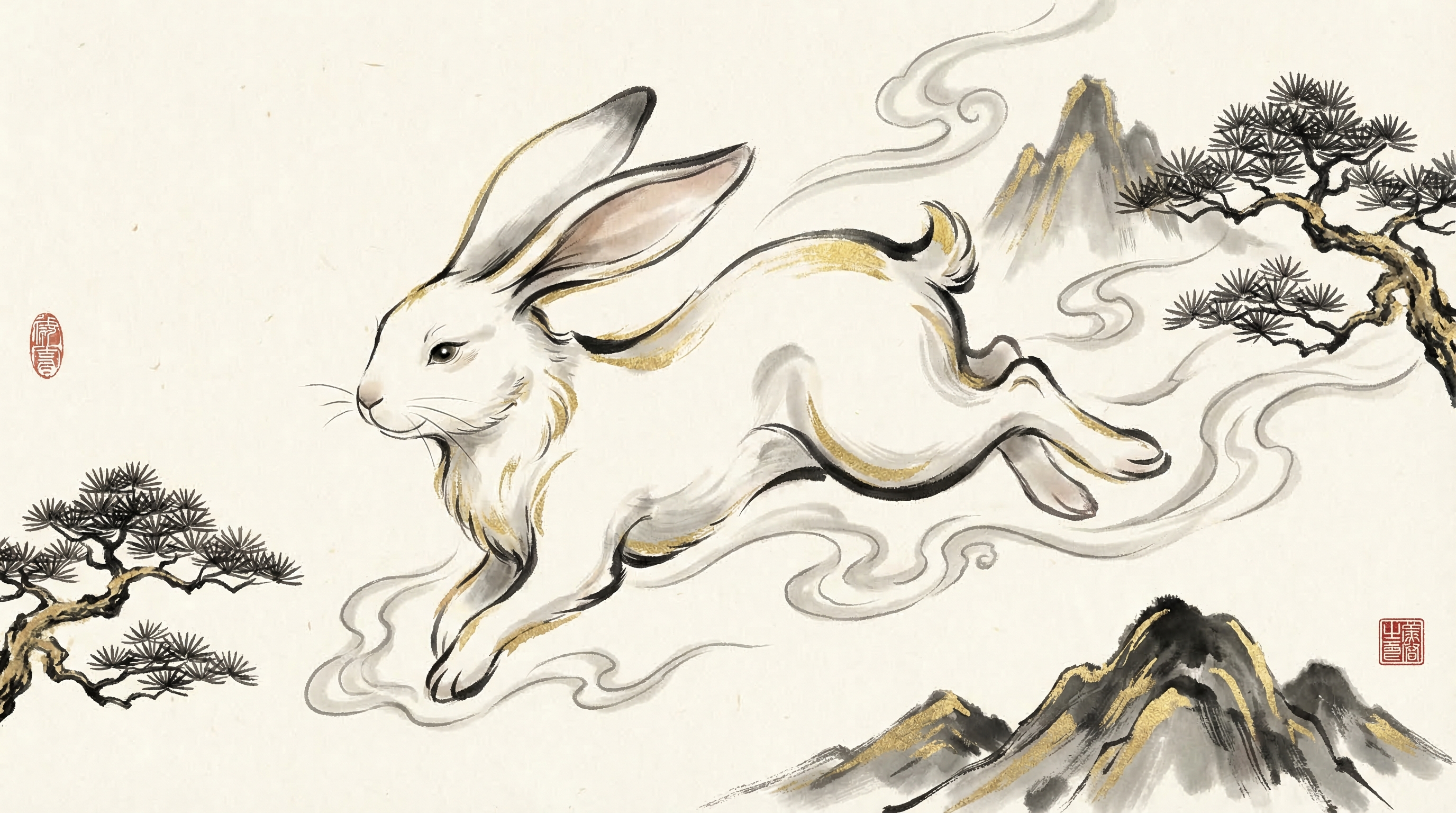
This article is part of our Chinese Zodiac series. New to BaZi? Start with our beginner's guide.
I once sat in on a board meeting at a consulting firm in Singapore where two department heads were going at it over budget allocation. Voices raised, faces red, the whole show. Then this woman in the corner, who hadn't said a word for twenty minutes, made one quiet suggestion. Both sides paused. Nodded. Meeting wrapped up in ten minutes flat, and everyone walked out thinking they'd won.
She had three Rabbit branches in her chart. Of course she did.
People describe the Rabbit as gentle, elegant, peace-loving. Sure, fine, all true. But those words make the Rabbit sound passive, and honestly? The Rabbit is anything but. One of the most strategically sharp branches in the entire zodiac. Doesn't win by fighting. Wins by making the fight pointless. And when conflict can't be sidestepped, it redirects, reframes, quietly dissolves the opposition. Voice never raised. Problem somehow solved anyway.
The Earthly Branch Mao (卯)
In BaZi (八字), the Rabbit corresponds to Mao (卯, mǎo), fourth of the Twelve Earthly Branches. Each branch has its own elemental energy, seasonal connection, hidden stems. The usual.
Mao is pure Yin Wood (乙, yǐ). Most branches contain multiple hidden stems, which means mixed energy pulling in different directions. Not Mao. It's got one hidden stem: Yi Wood. That's it. One of the purest branches in the system, right alongside You (Rooster, pure Yin Metal) and Zi (Rat, pure Yin Water).
So what does purity mean in practice? Focused energy. No internal contradictions pulling it in different directions. All Wood, all Yin, all the time. What you see is what you get (though what you see can be deceptively soft).
Seasonal and directional qualities
Mao sits at the spring equinox, corresponding to March on the solar calendar. Due east on the compass. Wood energy is at full throttle here: growing season well underway, plants leafing out, everything turning green.
In the daily cycle, Mao covers 5:00 to 7:00 AM. Dawn. First light breaking through. There's something baked into this branch about fresh starts and quiet optimism, which honestly tracks with how Rabbit people tend to approach new situations.
Yi Wood: the hidden stem
The single hidden stem inside Mao is Yi Wood (乙). Think vines, flowers, grass. Flexibility over rigidity. Beauty, artistic sensitivity, social grace. Its Yang counterpart Jia Wood (甲) is the towering oak that stands firm in storms. Yi Wood? It bends with the wind. Survives because it doesn't resist.
Everything about the Rabbit's personality traces back to Yi Wood. The diplomacy. The aesthetic eye. The conflict avoidance. That quiet stubbornness hiding underneath the pleasantness. All Yi Wood.
The Peach Blossom connection
Mao is one of the four Peach Blossom (桃花, táohuā) stars in BaZi. Specifically, it's the Peach Blossom for the water frame (Shen-Zi-Chen, or Monkey-Rat-Dragon group). When Mao shows up in a chart for someone in this frame, it cranks up attractiveness, romantic appeal, social magnetism.
Even outside the water frame though, Mao carries a natural Peach Blossom quality. Rabbit people tend to be good-looking, or at least have a charm that pulls people in. They know how to present themselves. And they understand, almost without thinking about it, what makes other people feel comfortable.
Curious whether Mao appears in your chart? Get your free BaZi reading and see exactly where the Rabbit sits in your four pillars.
Personality traits of the Rabbit
Layered personality, the Rabbit. Smooth and graceful on top. But there's a sharpness underneath that most people don't clock until it's already done its work.
Diplomacy and tact
This is the Rabbit's calling card. They walk into rooms full of conflicting agendas and somehow find a path that satisfies everyone, or at least leaves nobody feeling like they lost. Natural negotiators, because they pick up on what each person actually wants beneath the official position.
It goes way beyond politeness. Rabbit people read social dynamics the way a chess player reads the board. Three moves ahead, positioning accordingly. The result looks effortless. That's part of the strategy.
Aesthetic sensitivity
Mao's Yi Wood gives the Rabbit genuinely refined taste. They notice things other people walk right past: the color palette of a room, how light falls at a particular hour, the rhythm of a well-written sentence. Their opinions about design, fashion, music aren't performative. They've actually thought about it.
And they don't just appreciate beauty. They create it. Their homes tend to be carefully arranged. Personal style has coherence. A friend of mine with strong Rabbit energy once spent forty-five minutes rearranging three books on a shelf because "the spines clashed." I thought she was joking. She was not.
Conflict avoidance: the double edge
Here's where things get complicated. The same instinct that makes Rabbits brilliant diplomats also makes them avoidant. They'll go to extraordinary lengths to dodge direct confrontation, even when confrontation is exactly what the situation demands.
When it's healthy, it looks like wisdom. Not every fight is worth having, and nobody understands that better than the Rabbit.
When it's not healthy? Important conversations get deferred forever. Real grievances go unspoken. Problems get papered over with niceness until they rot underneath. I've seen Rabbit people stay in jobs, relationships, living situations that made them miserable for years because leaving would've required one uncomfortable conversation.
Quiet ambition
Don't let the gentleness fool you. Rabbit people are ambitious. They want success, recognition, influence. They just go after it differently than a Tiger or Dragon would.
The Rabbit advances through relationships, reputation, and strategic positioning. Cultivating the right connections. Making themselves indispensable to the right people. Building influence quietly, and by the time anyone notices how much power they've accumulated, it's already settled. This approach works especially well in hierarchical or political environments (think government agencies, large law firms, academic departments) where who you know matters as much as what you can do.
Emotional intelligence
Rabbit people pick up on shifts in mood, unspoken tensions, the gap between what someone says and what they actually feel. Excellent counselors, mediators, friends.
But absorbing everyone else's feelings is exhausting. Rabbit people need regular solitude to decompress. Without it, they get anxious, irritable, eventually withdrawn. It's not antisocial. It's maintenance.
Career paths
Communication, aesthetics, relationships, strategy. That's where Rabbit energy shines professionally. Put them in a constant high-pressure confrontation environment and they'll wilt. But give them a role where finesse matters? Watch them go.
Where the Rabbit thrives
Diplomacy and international relations. Finding common ground across cultures, navigating protocol, reading between the lines. Ambassadorial roles, NGO work, trade negotiations. A Rabbit I know spent twelve years at a consulate in Vancouver and said her whole job was basically "making sure nobody felt insulted."
Arts and design. Interior design, fashion, graphic design, photography, landscape architecture. Any field where aesthetic judgment matters. They don't just have good taste. They can explain why something works, then turn that into practical decisions.
Counseling and therapy. Their emotional intelligence and ability to create safe spaces make them effective therapists and coaches. They listen without judging and help people find answers rather than imposing their own.
Human resources. Reading people, managing interpersonal dynamics, mediating conflicts, building culture. All Rabbit specialties.
Writing and journalism. Yi Wood has a natural affinity for language. Many Rabbit people write well, with an ear for rhythm and an eye for the specific detail that makes a story come alive. Feature journalism, fiction, copywriting, editorial work.
Law and mediation. Not the aggressive courtroom drama variety. The kind where disputes get resolved before trial. Settlement conferences, collaborative divorce, commercial mediation.
Where the Rabbit struggles
High-pressure sales that require pushy tactics drain them fast. Same with roles demanding constant confrontation: debt collection, enforcement, aggressive litigation. Rabbits can manage in short bursts, but sustained combat depletes them.
Leadership roles requiring unpopular decisions are tough too. The Rabbit wants everyone happy, and leadership inevitably means disappointing people. The Rabbits who lead effectively have made peace with being occasionally disliked. Doesn't come easy.
Relationships and love
Attentive. Romantic. Sort of annoyingly good at remembering what you like. Dating a Rabbit feels good because they actually pay attention. They make you feel seen, which, let's be real, is half of what anyone wants in a relationship.
How the Rabbit loves
Thoughtfulness is the love language. They're the partner who remembers the exact variety of tulip you mentioned three months ago and has them on the table after you've had a bad week. They plan dates around what you enjoy. They bring up things you said weeks later, proving they were actually paying attention (which, honestly, is rarer than it should be).
They also care about beauty in the relationship itself. How you look together, the home you build, the little rituals. Rabbit people want the partnership to feel intentional, not thrown together.
Relationship challenges
Conflict avoidance hits hardest in intimate relationships. When something bothers them, they often won't say so directly. The dissatisfaction leaks out sideways instead: withdrawal, subtle cooling, passive comments that leave their partner confused and off-balance.
Over time, the pattern gets destructive. The partner feels like they're walking on eggshells without understanding why. The Rabbit feels resentful because their needs aren't being met, but hasn't actually stated those needs out loud. Both end up lonely inside a relationship that looks perfectly fine from the outside.
Rabbit people can also be quietly manipulative (though rarely in a mean-spirited way). Guilt, strategic silence, well-timed vulnerability to get what they want without asking directly. The healthiest Rabbits are the ones who've learned to just say what they need. Uncomfortable, but it works better.
Compatibility highlights
In BaZi, real compatibility depends on the full chart, not just zodiac matching. But certain branch interactions do create natural affinity or friction.
The Rabbit has a Six Harmony (六合, liùhé) combination with the Dog (Xu). Rabbit, Goat, and Pig share the wood frame San He and tend to understand each other almost instinctively.
The hardest match is usually the Rooster (You), the Rabbit's direct clash partner. Metal against Wood, bluntness against diplomacy. Neither side can figure out why the other one operates that way.
Want to see how your chart interacts with someone else's? Try our free BaZi reading to discover your full branch interactions.
Combinations and clashes
Earthly Branches interact through combinations, clashes, punishments, and harms. Mao participates in several significant ones, and this is where chart reading gets genuinely complex.
Mao-Xu combination: Rabbit and Dog (六合)
Mao (Rabbit) and Xu (Dog) form one of the Six Harmonies (六合), a powerful combination producing Fire energy when these two branches meet. Natural pairing. The Rabbit's grace complements the Dog's loyalty. The Dog gives the Rabbit courage to stand firm. The Rabbit shows the Dog that not everything requires a fight.
In chart reading, a Mao-Xu combination often points to a meaningful relationship between whatever life domains those pillars represent.
Mao-You clash: Rabbit and Rooster (六冲)
The Rabbit's primary clash. Direct Wood-Metal collision. You (Rooster) is pure Yin Metal (辛), Mao (Rabbit) is pure Yin Wood (乙). Metal chops Wood. Both branches are single-element, so there's nothing to cushion the impact. Clean, sharp, impactful.
How it plays out: diplomacy versus bluntness. The Rooster says what it thinks, plainly, sometimes harshly. The Rabbit communicates through suggestion and implication. They're basically speaking different languages.
When this clash shows up through an annual or Luck Cycle pillar, expect disruptions to whatever the clashing branch governs in your chart.
Zi-Mao punishment: Rat and Rabbit (无礼之刑)
Zi (Rat) and Mao (Rabbit) form one of the "rude punishments" (无礼之刑, wúlǐ zhī xíng). Subtler than a clash, but it creates a specific kind of friction: boundary violations, social impropriety, situations where politeness masks something unhealthy.
Shows up often in charts of people who struggle with boundaries in relationships. Enmeshment, codependency, relationships that look pleasant but involve quiet power imbalances underneath. Very Rabbit problem. Everything looks fine, but something's off.
Hai-Mao-Wei: the wood frame San He (三合)
Hai (Pig), Mao (Rabbit), and Wei (Goat) form the wood element San He (三合, sān hé), one of the four Grand Combinations. All three in a chart? Extremely powerful wood formation.
Mao is the "emperor" branch at the center of this trinity, the peak expression of wood. Two or three of these branches in your chart amplifies growth, kindness, creativity, flexibility, expansion. But it also intensifies wood's downsides: indecisiveness, over-accommodation, trouble setting boundaries.
The San He wood frame is also key for determining Peach Blossom stars. If you've got the water frame (Shen-Zi-Chen), Mao itself is your Peach Blossom.
The Rabbit in different pillars
Location matters. A lot. Same Rabbit energy expresses totally differently depending on which pillar it lands in.
Year pillar: social identity and ancestry
Mao in the Year Branch suggests a gentle, cultured upbringing. Family probably valued education, arts, social propriety. Emphasis on manners and appearance in the household.
People with this placement tend to project refinement and approachability. Others see them as pleasant, well-mannered, easy to be around. Good for opening doors. Less good if it becomes pressure to maintain a perfect front at all times.
Month pillar: career and parents
One of the strongest placements for career success in people-facing fields. Rabbit energy lands directly in the career palace, amplifying diplomatic abilities, aesthetic sense, networking instincts.
The parental relationship (particularly with the father in traditional readings) tends to be harmonious but possibly surface-level. There may be a family pattern of keeping things pleasant rather than dealing with difficult truths. Sound familiar?
Day pillar: core self and marriage
Mao in the Day Branch (the Spouse Palace) is significant. It suggests a partner who's graceful, attractive, socially skilled, or that those are the qualities you're drawn to. The marriage will prioritize harmony and aesthetic values.
The risk? Same as everywhere with Rabbit energy. Important things go unsaid. Couples with this placement need to build honest communication habits early, before polite avoidance becomes the default. For more on what your Day Branch reveals about relationships, see our Spouse Palace guide.
Hour pillar: inner world and children
Mao in the Hour Branch points to an inner world rich with imagination, beauty, creative impulse. Their private self is gentler and more artistic than what they show publicly. Secret sketchbooks, strong opinions about typefaces, a Spotify library that would surprise their coworkers.
Children with Hour Branch Mao parents often turn out sensitive, artistic, emotionally perceptive. The parent-child relationship tends to be warm but carries the same communication challenges that follow Mao everywhere.
Health considerations
In traditional Chinese medicine (which shares its theoretical framework with BaZi), each element governs specific organ systems. Wood rules the liver, gallbladder, tendons, eyes, and nervous system.
Liver health
Mao's pure Wood energy makes the liver a primary concern for strong Rabbit charts. In Chinese medicine, the liver is responsible for smooth Qi flow throughout the body. When liver energy stagnates? Irritability, mood swings, digestive issues, a feeling of being stuck.
Rabbit people are particularly susceptible because they tend to suppress emotions. Every frustration swallowed, every grievance left unspoken, contributes to stagnation. Regular physical movement helps, especially stretching and twisting (yoga, tai chi, even just a good morning stretch routine).
Nervous system sensitivity
Yi Wood people tend toward sensitive nervous systems. Easily overstimulated by noise, crowds, conflict. Not a disorder. It's baked into the energetic makeup. But it means they need to manage environments more carefully than some other types.
Good sleep, limited caffeine, regular time in nature. The Wood element is nourished by forests, gardens, green spaces. Time outdoors isn't optional for Rabbit people. It's basically medicine.
Skin sensitivity
Yin Wood also connects to skin and surface tissues. Rabbit people may experience skin sensitivities, allergies, or reactions to environmental irritants more readily. Chinese medicine links many skin conditions to internal heat or stagnation, which circles back to liver health again.
For a deeper look at how the five elements connect to health, see our Five Element Wellness guide.
Frequently asked questions
Is the Rabbit a weak animal in BaZi?
No. Soft isn't weak. The Rabbit carries undiluted Yi Wood energy, and pure branches are focused and powerful in their element. The Rabbit's strength lies in influence, strategy, relationship management. Equating softness with weakness misunderstands how energy works in BaZi. A vine that bends in a hurricane survives when the rigid oak snaps.
What years are Rabbit years?
Recent and upcoming: 1951, 1963, 1975, 1987, 1999, 2011, 2023, 2035. But your zodiac year only determines the Earthly Branch in your Year Pillar. Month, Day, and Hour branches could be anything. That's why BaZi is so much more precise than zodiac-only astrology. For the full picture, see Chinese Zodiac vs BaZi.
How does the Rabbit interact with the Day Master?
The Rabbit (Mao) is an Earthly Branch, and the Day Master is a Heavenly Stem. Their interaction depends on your Day Master's element. Metal Day Master (Geng or Xin)? Mao is your Wealth element, since Metal controls Wood. Water Day Master (Ren or Gui)? Mao is your Output element, since Water nourishes Wood. Changes with each Day Master, which is why full chart analysis matters more than looking at branches in isolation.
Can the Rabbit be a Peach Blossom star for anyone?
Mao functions as the Peach Blossom star specifically for people with water frame branches (Shen, Zi, or Chen) in their chart. If you've got any of these in your Year or Day pillar and Mao appears elsewhere (or arrives through a Luck Cycle), it activates Peach Blossom energy: increased attractiveness, romantic opportunities, social charm.
What should Rabbit people watch out for in Rooster years?
Rooster years (You years) bring the Mao-You clash. Direct Metal-against-Wood collision that can disrupt whatever life area the clashing pillar governs. Mao in your Day Branch? Rooster year might shake up your relationship. Month Branch? Expect career shifts. The clash isn't automatically negative. It forces change, and sometimes that's exactly what was needed. But preparation beats surprise. Read more in our Six Clashes guide.
Understanding your Rabbit energy
Look, the Rabbit is probably the most misunderstood branch in BaZi. People see elegance and gentleness and think that's the whole story.
It's really not. There's a sharp strategic mind in there, deep emotional intelligence, real ambition. The Rabbit doesn't announce itself. It just... gets there.
The core challenge? Knowing when harmony matters and when honesty matters more. Balanced well, the Rabbit makes the world more civilized, more beautiful, genuinely more humane. Taken too far, it becomes a gilded cage of pleasant fictions nobody dares disrupt.
Learning when to bend and when to stand. When to smooth things over and when to say the uncomfortable thing out loud. That's the Rabbit's lifelong curriculum.
Ready to discover where the Rabbit appears in your chart and what it means for your life? Get your free BaZi reading and explore your full four-pillar blueprint.
If you're interested in the elements shaping the Rabbit's energy, our Five Elements guide explains how Wood interacts with the other four elements. And for a complete understanding of how your Day Master relates to branches like Mao, visit our Day Master guide.